

Special Education for Children with Learning Disabilities: A Complete Guide for Indian Parents
Every parent imagines their child sitting happily in a classroom, learning, making friends, raising their hand to answer questions. But for thousands of children across India, school is not that experience. For children with learning disabilities, every school day can feel like being asked to run a race with a broken leg — not because they are not trying hard enough, but because the standard approach to teaching simply does not match the way their brain works.
If your child struggles with reading, writing, spelling, maths, or following classroom instructions — despite clearly being intelligent and trying their best — a learning disability may be the reason. And the most important thing you can know is this: a learning disability is not a measure of intelligence or potential. With the right specialised support, children with learning disabilities can learn, grow, and achieve extraordinary things.
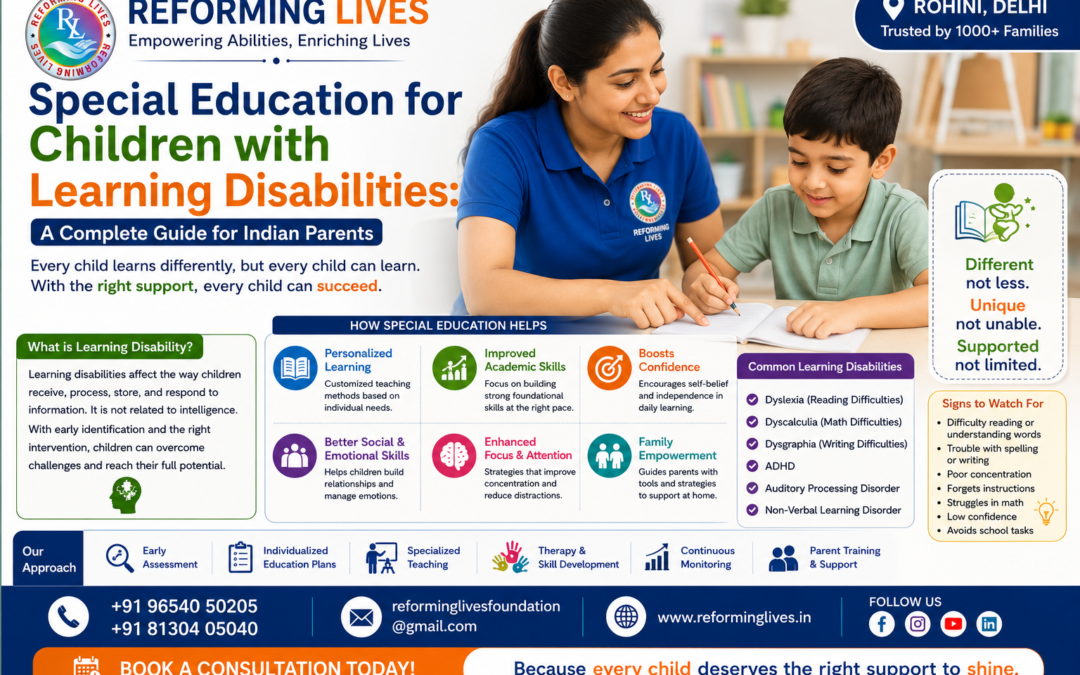
At Reforming Lives in Sector 16, Rohini, Delhi, our Special Education programme — delivered by qualified, RCI-certified Special Educators — is designed specifically for children who need a different approach to learning. This article explains what learning disabilities are, what special education involves, and how the right support can change your child’s educational journey entirely.
What Are Learning Disabilities?
A learning disability is a neurological condition that affects how the brain processes, stores, and communicates information. It is not caused by poor parenting, inadequate schooling, or lack of effort. It is a different kind of brain — one that needs to be taught differently, not harder.
Learning disabilities are typically identified when a child shows a significant gap between their intellectual ability (which may be average or above average) and their academic achievement in specific areas. They are not the same as intellectual disabilities, though the two can sometimes co-exist.
Learning disabilities exist on a spectrum from mild to severe, and they affect children from all backgrounds and family types.
Types of Learning Disabilities in Children
📌 Dyslexia (Reading Disability)
The most common learning disability. Children with dyslexia have difficulty decoding words, reading fluently, spelling accurately, and sometimes understanding written text. They are NOT unintelligent — in fact, many highly creative and successful adults have dyslexia.
Common signs:
- Difficulty learning to read despite efforts
- Confusing similar letters like b/d or p/q
- Very slow, laboured reading
- Poor spelling even of common words
- Difficulty sounding out new words
📌 Dysgraphia (Writing Disability)
Children with dysgraphia struggle significantly with handwriting — the physical act of writing is effortful, the results are illegible, and organising thoughts on paper is extremely challenging.
Common signs:
- Very poor, inconsistent handwriting
- Difficulty holding a pencil correctly
- Letters and words cramped, oddly spaced, or irregular in size
- Avoiding writing tasks
- Large difference between verbal ability and written output
📌 Dyscalculia (Maths Disability)
Children with dyscalculia have significant difficulty understanding numbers, number concepts, and mathematical reasoning.
Common signs:
- Difficulty learning and remembering basic number facts
- Struggling to understand concepts like more/less, time, money
- Confusion with mathematical symbols
- Difficulty with mental arithmetic
📌 Auditory Processing Disorder
Children with auditory processing disorder hear perfectly well but the brain has difficulty processing and making sense of what it hears — affecting reading, spelling, and following spoken instructions.
📌 Visual Processing Disorder
Difficulty processing visual information despite having normal vision — affecting reading, writing, maths, and spatial reasoning.
📌 Non-Verbal Learning Disability
Strong verbal skills but significant difficulties with visual-spatial tasks, maths, social cues, and adapting to new situations.
Signs of Learning Disabilities Parents Should Watch For
These are the signs that suggest a child may have a learning disability and would benefit from a special education assessment:
- Consistently struggles in one or more academic subjects despite genuine effort
- Reading below the level expected for their age
- Significant difficulty with handwriting or written expression
- Confusion with letters, numbers, or mathematical symbols
- Difficulty following multi-step instructions in the classroom
- Very slow to complete tasks compared to peers
- Significant difference between how well they speak and how well they write
- Frequently labelled as “lazy,” “careless,” or “not trying hard” by teachers
- Shows signs of anxiety, reluctance, or physical symptoms (headaches, stomach aches) before school
- Avoids reading, writing, or homework consistently
- Low self-esteem related to academic performance
Very important: Many children with learning disabilities are also highly creative, verbally articulate, and socially skilled. Intelligence is NOT the issue. Teaching approach is.
How Learning Disabilities Affect Children Emotionally
The academic struggles caused by learning disabilities rarely stay in the classroom. They follow children home, into their self-image, and into their relationships.
Children with unidentified or unsupported learning disabilities frequently:
- Develop chronic low self-esteem — “I’m stupid, that’s why I can’t read”
- Experience anxiety and school refusal — dreading every school day
- Feel shame and embarrassment in front of peers
- Develop behaviour problems — acting out in class is often easier than being seen to struggle
- Have strained relationships with parents — homework becomes a daily battle
- Experience depression in older children, as repeated failure accumulates
The emotional consequences of an unsupported learning disability can be as significant and damaging as the academic ones. Early identification and the right support protects your child’s mental health as much as their academic future.
What Is Special Education and How Does It Help?
Special Education is a specialised form of teaching specifically designed to meet the unique learning needs of children with developmental disabilities, learning disabilities, sensory impairments, or other special needs.
It is NOT about lowering expectations. It is about finding the teaching approach that unlocks each child’s learning potential.
Special Educators are trained professionals — at Reforming Lives, our special educators are RCI (Rehabilitation Council of India) certified, meaning they have undergone rigorous professional training specifically in teaching children with special needs.
How Special Education Differs from Regular Teaching:
| Regular Classroom | Special Education |
|---|---|
| Standard curriculum pace | Individualised pace for each child |
| One teaching approach for all | Multiple teaching modalities (visual, auditory, kinesthetic) |
| Group instruction | Small group or one-on-one instruction |
| Standard assessment methods | Modified assessments suited to the child |
| Limited accommodation | Comprehensive accommodations and adaptations |
| Focus on grade-level content | Focus on foundational skill building |
The Reforming Lives Special Education Programme
At Reforming Lives, our Special Education programme is one of the most comprehensive in Rohini and North Delhi. Our qualified special educators — including Ms. Anjali (RCI certified, specialising in Intellectual Disability, CRR No. B104689) and Ms. Lawanya (RCI certified, Multiple Disability, CRR No. B142514) — bring genuine expertise, warmth, and commitment to every child they teach.
Here is what our programme involves:
🟢 Individual Learning Assessment
Every child in our special education programme begins with a comprehensive educational assessment — identifying specific areas of strength and difficulty, learning style, processing abilities, and current academic levels.
🟢 Individual Education Plan (IEP)
Based on the assessment, we create a detailed, personalised Individual Education Plan with clear, measurable goals across all learning areas — reviewed and updated regularly in partnership with parents.
🟢 Multi-Sensory Teaching Approaches
Children with learning disabilities learn best when information is presented through multiple senses simultaneously — seeing, hearing, touching, and doing. Our special educators use evidence-based multi-sensory teaching methods to build reading, writing, maths, and comprehension skills.
🟢 Pre-Academic School
Our Pre-Academic School at Reforming Lives provides a structured, nurturing classroom environment specifically designed for children with special needs. It combines special education with therapy support, social skills building, and play-based learning — preparing children for greater independence in their academic journey.
🟢 IQ and SQ Assessment
At Reforming Lives, we offer IQ and SQ Assessment — evaluating a child’s intellectual abilities and social skills to build a clearer picture of their learning profile and identify the most effective educational approach.
🟢 Integration with Therapy
Our special educators work directly alongside our OT therapists, speech therapists, and psychologists — because learning disabilities rarely exist in isolation. Children with dyslexia may also need visual processing support from OT. Children with auditory processing issues may need speech therapy. A fully integrated approach produces the best outcomes.
🟢 Parent Guidance and Home Support Strategies
We provide parents with practical strategies to support learning at home — including how to make homework less stressful, how to build reading and writing skills in everyday life, and how to advocate for your child in their school environment.
Practical Tips for Parents of Children with Learning Disabilities
- Never call your child lazy or stupid — they are working harder than you know
- Focus on what your child can do well and build their confidence there
- Break homework into small chunks with movement breaks in between
- Use audiobooks alongside print to support reading development
- Allow extra time for written tasks — pressure makes processing harder
- Find your child’s learning modality — are they a visual learner? An auditory learner? A hands-on learner?
- Communicate openly with teachers — share your child’s diagnosis and what strategies work at home
- Advocate firmly but respectfully for accommodations in school — your child has a right to appropriate support
- Remind your child daily: “You learn differently, not less.”
Every Child Deserves a Chance to Learn Their Way
At Reforming Lives, we have sat with children who were told they would never learn to read — and watched them read aloud with pride. We have worked with children labelled “slow” who are now thriving in inclusive classrooms. We have seen parents who arrived at our door defeated leave with renewed hope and a clear plan.
Learning disabilities are not ceilings. They are simply different starting points on a different path — and at Reforming Lives, we specialise in finding and walking that path with your family.
Your child has the capacity to learn. Let our expert special educators help them discover how.
📞 Book a Special Education consultation today:
🏥 Reforming Lives — Children’s Rehabilitation & Therapy Centre 📍 Block I4/23-24-25, Sector 16, Rohini, Delhi 📱 Reception: +91 96540 50205 | Office: +91 8130405040 📧 reforminglivesfoundation@gmail.com 🌐 www.reforminglives.in 📲 Facebook | Instagram | YouTube | LinkedIn: @reforminglives
❓ Frequently Asked Questions (FAQs)
1. What is the difference between a learning disability and an intellectual disability?
A learning disability affects specific academic skills (reading, writing, maths) while general intelligence is typically average or above average. An intellectual disability affects overall cognitive functioning and adaptive behaviour across all areas. A child can have one, both, or neither — professional assessment clarifies this.
2. How is a learning disability diagnosed in India?
Learning disabilities are diagnosed through a comprehensive psycho-educational assessment conducted by a qualified psychologist or educational specialist. This includes IQ testing, academic achievement testing, and assessment of processing skills. At Reforming Lives, we offer IQ and SQ assessments as part of our evaluation services.
3. Can a child with a learning disability study in a regular school?
Many children with learning disabilities study in regular schools with appropriate accommodations and support. In India, the Rights of Persons with Disabilities Act 2016 mandates that schools provide reasonable accommodations. However, some children benefit significantly from special education settings, particularly in the early stages of skill-building.
4. Is special education only for children with severe disabilities?
No. Special education benefits children across the spectrum of learning differences — from mild specific learning disabilities like dyslexia to more complex developmental conditions. Any child who is not achieving their potential due to a learning difference can benefit from specially designed instruction.
5. How long does a child need special education?
This varies greatly depending on the child’s specific profile, the nature of their disability, and the quality and consistency of the support they receive. Some children with mild learning disabilities build the skills they need within a few years. Others benefit from special education support throughout their schooling.
6. What qualifications do special educators at Reforming Lives have?
Our special educators are certified by the Rehabilitation Council of India (RCI) — the national regulatory body for special education and rehabilitation in India. Ms. Anjali holds RCI certification in Intellectual Disability and Ms. Lawanya holds RCI certification in Multiple Disability. Both bring extensive experience and genuine dedication to their work.
7. How do I enrol my child in the special education programme at Reforming Lives?
Call us at +91 96540 50205 or +91 8130405040, email reforminglivesfoundation@gmail.com, or visit www.reforminglives.in to book an initial consultation. Our centre is at Block I4/23-24-25, Sector 16, Rohini, Delhi — easily accessible from Pitampura, Prashant Vihar, Shalimar Bagh, Mangolpuri, and across North Delhi.