

Down Syndrome Therapy and Support for Children: A Complete Guide for Indian Parents
The moment you learn your child has Down syndrome, your world shifts. Every parent’s experience of that moment is different — some feel grief, some feel fear, some feel a fierce, immediate love that surprises them with its intensity. Whatever you felt — or still feel — is valid.
What we know at Reforming Lives, from years of working with children with Down syndrome and their families across Rohini and Delhi NCR, is this: Down syndrome does not determine what your child can achieve. Therapy, support, and belief do.
Children with Down syndrome grow up to read, write, form friendships, pursue interests, and live rich, meaningful lives. The journey looks different from what you may have imagined — but it is filled with milestones that will move you to tears with pride, moments of pure joy, and a bond with your child that is unlike anything else in the world.
This guide covers everything Indian parents need to understand about Down syndrome, the therapies that help, and how Reforming Lives in Sector 16, Rohini, Delhi supports children with Down syndrome and their families.
What Is Down Syndrome?
Down syndrome (also called Trisomy 21) is a genetic condition caused by the presence of an extra copy of chromosome 21. Typically, humans have 23 pairs of chromosomes (46 total). In Down syndrome, there are three copies of chromosome 21 instead of two — giving a total of 47 chromosomes.
This extra genetic material affects how a child develops — physically, cognitively, and in terms of their health. Down syndrome is the most common chromosomal condition in humans, occurring in approximately 1 in 700 births worldwide, regardless of ethnicity, socioeconomic background, or family history.
Down syndrome is not caused by anything parents did or did not do. It is a chromosomal variation that occurs at conception. The only known risk factor is advanced maternal age — but the majority of children with Down syndrome are born to mothers under 35.
How Does Down Syndrome Affect Child Development?
Down syndrome affects development in several areas — but it is critical to understand that the degree of impact varies enormously from child to child. Down syndrome is a spectrum.
Cognitive Development
Children with Down syndrome typically have mild to moderate intellectual disability — meaning they learn more slowly and may need information presented differently. However, they have the capacity to learn, to develop skills, and to grow intellectually throughout their entire lives.
Speech and Language
Speech and language development is often significantly delayed in children with Down syndrome, due to:
- Low muscle tone (hypotonia) in the mouth and face
- Smaller mouth cavity and larger relative tongue size
- Auditory processing differences
- Hearing loss (very common in Down syndrome)
Most children with Down syndrome understand far more than they can express verbally, and their comprehension consistently develops ahead of their expressive speech.
Motor Development
Low muscle tone (hypotonia) affects motor development significantly:
- Reaching physical milestones like sitting, crawling, and walking is typically delayed
- Gross motor skills — walking, running, climbing — develop but may look different
- Fine motor skills — grasping, manipulating objects, writing — also require targeted support
Health Considerations
Children with Down syndrome have a higher risk of:
- Congenital heart defects (present in approximately 40–50% of children with DS)
- Hearing loss
- Vision problems
- Thyroid disorders
- Respiratory issues
- Sleep apnea
This is why regular medical monitoring, in addition to developmental therapy, is essential.
Social and Emotional Development
One of the most wonderful aspects of Down syndrome that parents and therapists consistently report is the warmth, empathy, and social nature of many children with Down syndrome. They are often deeply loving, socially motivated, and emotionally attuned — qualities that are a genuine asset in building relationships and integrating into community life.
Why Early Therapy Is Critical for Children with Down Syndrome
The first five years of life are the window of greatest brain plasticity. For children with Down syndrome, this is the period when targeted therapy can make the most dramatic difference to motor development, communication, and cognitive skills.
Early and consistent therapy:
- Minimises the functional impact of low muscle tone
- Builds communication foundations before school age
- Develops daily living skills and independence
- Supports cognitive development during the most teachable years
- Prepares children for integration into educational settings
Do not wait for a “significant delay” to begin therapy. Start as early as possible — from infancy if possible.
Comprehensive Down Syndrome Therapy at Reforming Lives
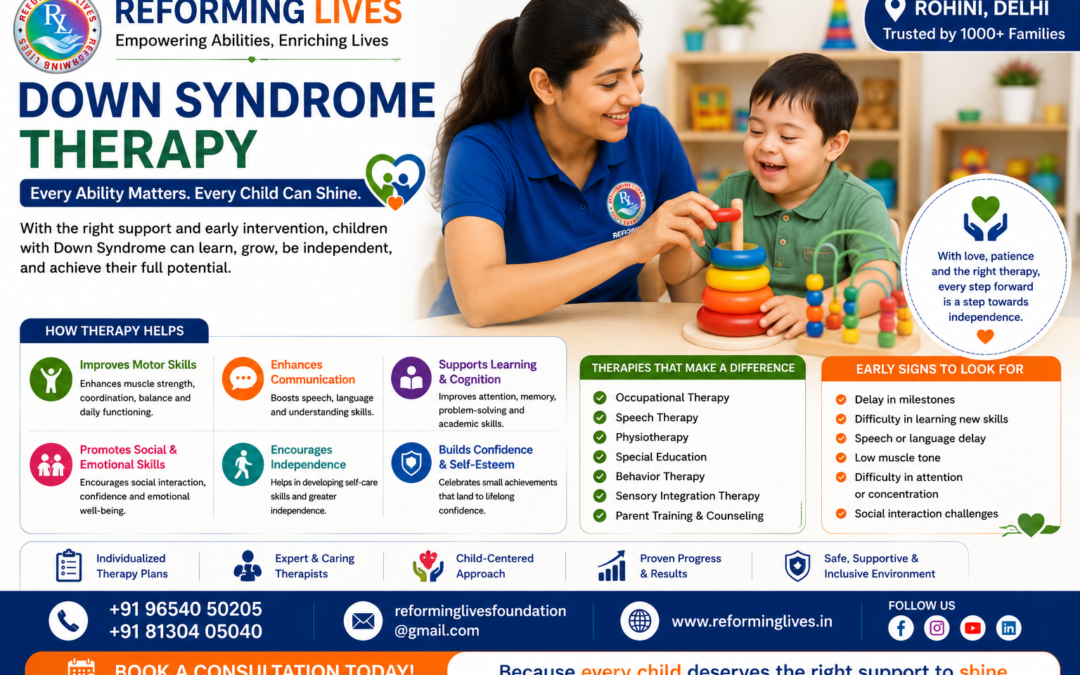
At Reforming Lives in Rohini, Delhi, we offer a fully integrated, multi-disciplinary therapy programme for children with Down syndrome — combining all the key interventions under one roof, coordinated by our expert team.
🟢 Physiotherapy — Building Motor Strength and Function
Low muscle tone is one of the most significant challenges in Down syndrome. Our Physiotherapists at Reforming Lives work from infancy to:
- Build core strength and stability — the foundation of all movement
- Develop head control, rolling, sitting, crawling, standing, and walking
- Improve balance, coordination, and body awareness
- Address joint hypermobility (over-flexibility) safely
- Prevent secondary musculoskeletal complications
🟢 Neuro Developmental Therapy (NDT)
Our certified NDT approach addresses the neurological aspects of motor development in Down syndrome — improving the quality of movement and postural control through hands-on, specialised techniques.
🟢 Speech and Language Therapy
Speech development is one of the most important therapy priorities for children with Down syndrome. Our Speech Therapists work on:
- Oral motor development — building the muscle tone and coordination of the mouth and tongue
- Early communication — babbling, pointing, joint attention, and gesture-based communication before spoken words emerge
- Vocabulary and language — building understanding and expressive vocabulary
- Signing and visual supports — many children with Down syndrome benefit enormously from Makaton signing or PECS alongside verbal speech, as their visual learning abilities are typically strong
- Articulation — helping words become clearer and more intelligible as speech develops
- Feeding therapy — addressing feeding difficulties related to oral motor hypotonia
🟢 Occupational Therapy
Our OT team supports children with Down syndrome in developing:
- Fine motor skills — grasping, handwriting, using scissors, self-feeding
- Daily living skills — dressing, toileting, personal hygiene
- Sensory processing — many children with DS have sensory sensitivities
- Visual motor integration — coordinating what the eyes see with what the hands do
- School readiness skills
🟢 Sensory Integration Therapy
Children with Down syndrome often present with sensory processing differences. Our Sensory Integration Therapy helps regulate the nervous system, improving a child’s ability to engage and learn.
🟢 Early Intervention Programme
Our comprehensive Early Intervention programme is specifically designed for young children with conditions like Down syndrome — providing coordinated, intensive, family-centred therapy during the critical developmental window.
🟢 Special Education
Our RCI-certified Special Educators — Ms. Anjali and Ms. Lawanya — provide structured, individualised learning support for children with Down syndrome, building literacy, numeracy, and life skills using multi-sensory teaching approaches suited to each child’s learning style.
🟢 Pre-Academic School
Our Pre-Academic School at Reforming Lives provides children with Down syndrome a warm, inclusive, structured learning environment — building school readiness, social skills, and functional independence.
🟢 Hearing Test and Trial
Given the high prevalence of hearing loss in Down syndrome, our Hearing Test and Trial service is an essential part of every child’s care programme at Reforming Lives. Addressing hearing difficulties early is critical for speech and language development.
🟢 IQ and SQ Assessment
Our IQ and SQ Assessment service helps build a complete picture of your child’s cognitive and social profile — guiding educational planning and therapy goals.
Practical Tips for Parents of Children with Down Syndrome at Home
- Follow the home programme from all therapists consistently — daily practice is what drives progress
- Use visual supports — picture schedules, visual instructions, and Makaton signs reinforce learning powerfully
- Encourage independence — resist doing things for your child that they can attempt themselves
- Read together every day — even before your child can speak, shared reading builds vocabulary and language
- Sing nursery rhymes — rhythm and melody support language development beautifully
- Build oral motor skills — encourage blowing bubbles, using straws, and eating a range of textures
- Celebrate every milestone — in Down syndrome, every milestone is earned through real effort
- Connect with the Down syndrome community — parent networks provide invaluable support, shared wisdom, and friendship
A Message of Hope for Every Parent
Your child with Down syndrome will surprise you. They will reach milestones you were told might not happen. They will make you laugh and fill your home with warmth. They will teach you things about patience, perseverance, and joy that you could not have learned any other way.
At Reforming Lives, we have walked this journey with so many families. We have seen children with Down syndrome who could barely hold their heads up learn to walk. We have watched children who were non-verbal at age 3 communicate meaningfully by age 6. We have helped families in Rohini, Pitampura, and across Delhi NCR find their footing and their hope.
Your child’s potential is greater than any diagnosis. Our team at Reforming Lives is here to help them reach it.
📞 Book a Down Syndrome therapy consultation today:
🏥 Reforming Lives — Children’s Rehabilitation & Therapy Centre 📍 Block I4/23-24-25, Sector 16, Rohini, Delhi 📱 Reception: +91 96540 50205 | Office: +91 8130405040 📧 reforminglivesfoundation@gmail.com 🌐 www.reforminglives.in
❓ Frequently Asked Questions (FAQs)
1. Can children with Down syndrome go to a regular school?
Many children with Down syndrome are successfully included in mainstream schools with appropriate support. Others benefit more from a special school or blended setting. The right choice depends on the individual child’s profile. Our team at Reforming Lives can help assess which setting will best support your child.
2. At what age should therapy begin for a child with Down syndrome?
From birth, ideally — or as soon as possible after diagnosis. Early physiotherapy, speech therapy, and OT during the first years of life produce the greatest developmental gains. Do not wait for your child to “fall behind” before starting.
3. Will my child with Down syndrome be able to speak?
Most children with Down syndrome do develop functional spoken language, though the timeline is typically delayed. The extent of verbal communication varies. With consistent Speech Therapy, oral motor work, and visual communication supports, most children with DS develop meaningful communication. Many children benefit enormously from learning signing alongside speech.
4. How does low muscle tone (hypotonia) affect development?
Hypotonia means the muscles have lower than typical tension, making them feel floppy. In Down syndrome, this affects physical development (delayed motor milestones), oral development (speech and feeding), and fine motor skills. Physiotherapy and OT directly address hypotonia through targeted strengthening exercises and developmental activities.
5. Is Down syndrome hereditary?
Most cases of Down syndrome (Trisomy 21) are not inherited — they result from a random chromosomal error during cell division. However, a less common type called Translocation Down syndrome can be inherited. Genetic counselling is recommended for families who wish to understand their specific situation.
6. What is the life expectancy of a person with Down syndrome?
Life expectancy for people with Down syndrome has improved dramatically — from an average of 25 years in the 1980s to over 60 years today, largely due to improved medical care and early intervention. Many people with Down syndrome live long, healthy, and fulfilling lives.
7. How do I access Down syndrome therapy at Reforming Lives?
Contact us at +91 96540 50205 or +91 8130405040, or email reforminglivesfoundation@gmail.com. Visit www.reforminglives.in to book your first consultation. We are at Block I4/23-24-25, Sector 16, Rohini, Delhi — welcoming families from Pitampura, Shalimar Bagh, Prashant Vihar, and across Delhi NCR.