

Cerebral Palsy Treatment and Therapy for Children: A Complete Guide for Indian Parents
When parents first hear the words “cerebral palsy” in relation to their child, the world can feel like it has stopped spinning. Questions flood in: Will my child ever walk? Will they speak? What kind of life will they have? The fear is overwhelming — and completely understandable.
But here is what the most experienced therapy professionals at Reforming Lives in Rohini, Delhi want every parent of a child with cerebral palsy to know: a cerebral palsy diagnosis is not a fixed destiny. With the right therapies, the right support, and the right team, children with CP make genuine, meaningful progress — and go on to live lives of real depth, connection, and achievement.
Cerebral palsy is one of the primary conditions we treat at Reforming Lives. Our multi-disciplinary therapy team has worked with children across the full spectrum of CP — from mild motor difficulties to complex, multiple-disability presentations — and we have witnessed extraordinary progress time and again.
What Is Cerebral Palsy?
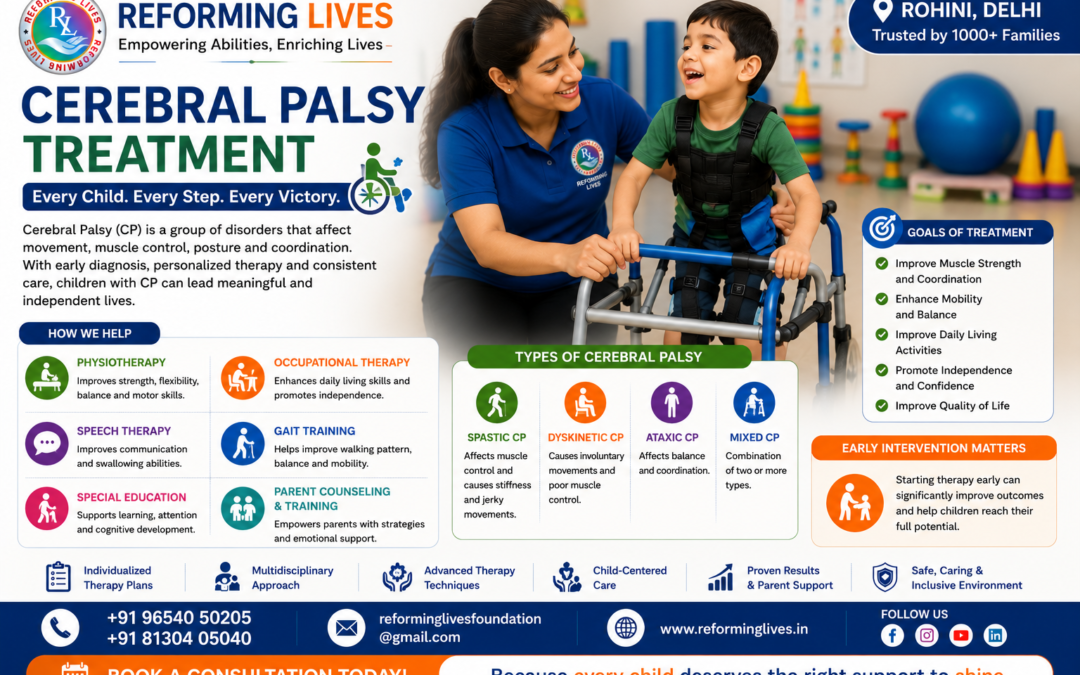
Cerebral Palsy (CP) is a group of neurological disorders that affect movement, muscle tone, and motor skills. It is caused by damage to or abnormal development of the brain — most commonly occurring before or during birth, or in the first few years of life.
“Cerebral” refers to the brain; “Palsy” refers to weakness or problems with movement. CP affects the way the brain communicates with the muscles — resulting in difficulties with movement, posture, and coordination.
Crucially: CP is non-progressive — the brain injury itself does not worsen over time. What changes is how the condition expresses itself as a child grows — and how much function a child develops depends enormously on the quality and consistency of therapy they receive.
CP affects approximately 2–3 per 1,000 births, making it the most common childhood physical disability worldwide.
Types of Cerebral Palsy
Understanding which type of CP your child has helps in designing the right therapy approach:
Spastic CP (Most Common — 70–80% of Cases)
Muscles are stiff and tight, making movement difficult and often jerky. Can affect both legs (diplegia), one side of the body (hemiplegia), or all four limbs and the trunk (quadriplegia).
Dyskinetic/Athetoid CP
Characterised by involuntary, slow, writhing movements — particularly of the hands, feet, arms, or legs. The muscle tone fluctuates between too tight and too loose.
Ataxic CP
Affects balance and coordination. Children with ataxic CP may have shaky, unsteady movements and difficulty with tasks requiring precision.
Mixed CP
Many children show features of more than one type — most commonly a combination of spastic and dyskinetic CP.
Causes of Cerebral Palsy
CP can result from any event that damages the developing brain:
Before birth (prenatal):
- Infections during pregnancy (rubella, cytomegalovirus)
- Stroke in the baby before birth
- Genetic mutations affecting brain development
- Oxygen deprivation (hypoxia) in the womb
During birth (perinatal):
- Birth asphyxia — oxygen deprivation during labour
- Very premature birth (especially before 28 weeks)
- Very low birth weight
- Traumatic birth injury
After birth (postnatal):
- Brain infections (meningitis, encephalitis)
- Traumatic brain injury
- Severe jaundice left untreated in newborns
Signs and Symptoms of Cerebral Palsy
Signs vary widely depending on type and severity, but commonly include:
In Infants:
- Unusual muscle tone — either very floppy or very stiff
- Developmental delays — not reaching milestones like rolling, sitting, or crawling on time
- Favoring one side of the body
- Feeding or swallowing difficulties
- Seizures
In Older Children:
- Difficulty walking — toe-walking, scissor gait, crouched gait
- Stiffness or spasticity in limbs
- Poor coordination and balance
- Involuntary movements
- Difficulty with fine motor tasks — writing, using cutlery
- Speech and communication difficulties
- Learning difficulties (in some children)
- Sensory impairments — visual or hearing difficulties
- Joint problems and contractures (muscle shortening)
How Cerebral Palsy Affects the Whole Family
Caring for a child with cerebral palsy is demanding — physically, emotionally, financially, and relationally. Indian families often face additional challenges: limited specialised services in many areas, lack of awareness in schools, societal stigma, and the physical demands of daily caregiving.
Parents frequently describe exhaustion, isolation, and grief — while simultaneously feeling profound love and fierce determination for their child. Both are real. Both are valid.
At Reforming Lives, we see the whole family — not just the child. Our team supports parents with guidance, practical strategies, and genuine compassion at every step of the journey.
Treatment and Therapy for Cerebral Palsy — What Actually Helps
There is no single cure for CP, but comprehensive, consistent, multi-disciplinary therapy significantly improves function, independence, and quality of life. The earlier therapy begins, the greater the impact — because the developing brain has the greatest capacity for adaptation in the early years.
Here is how Reforming Lives supports children with cerebral palsy:
🟢 Physiotherapy — The Foundation of CP Treatment
Physiotherapy is the cornerstone of cerebral palsy management. At Reforming Lives, our experienced physiotherapists work to:
- Improve muscle strength and flexibility
- Reduce spasticity (muscle stiffness) through stretching and positioning
- Develop gross motor skills — rolling, sitting, standing, walking
- Improve balance and coordination
- Prevent contractures — permanent muscle shortening that limits movement
- Recommend and train families in adaptive positioning — correct ways to hold, carry, and position your child
🟢 Neuro Developmental Therapy (NDT)
At Reforming Lives, we offer Neuro Developmental Therapy — a specialised, internationally recognised approach to treating movement dysfunctions in children with neurological conditions including cerebral palsy. NDT focuses on improving the quality of movement, normalising muscle tone, and building functional motor skills through hands-on, child-led techniques. Our lead therapist, Dr. Subodh Kumar [PT], holds NDT certification — bringing specialist expertise directly to your child.
🟢 Occupational Therapy
Our Occupational Therapists help children with CP develop:
- Fine motor skills — grasping, manipulating objects, using cutlery and pencils
- Daily living skills — dressing, feeding, personal care
- Adaptive strategies — finding modified ways to accomplish tasks when standard methods are difficult
- School skills — writing support, classroom adaptations
🟢 Speech and Language Therapy
Many children with CP have dysarthria — difficulty with the physical production of speech due to poor muscle control of the mouth, tongue, and breathing. Others have feeding and swallowing difficulties. Our Speech Therapists at Reforming Lives address both:
- Building oral motor strength and coordination
- Developing speech clarity and communication
- AAC (Augmentative and Alternative Communication) for children who are non-verbal
- Feeding and swallowing therapy for safe, comfortable eating
🟢 Sensory Integration Therapy
Children with CP often have accompanying sensory processing difficulties. Our Sensory Integration Therapy helps regulate the nervous system, improving sensory tolerance and readiness to engage in daily activities and therapy.
🟢 Eye-Hand Coordination Programme
Many children with CP struggle with the coordination between what they see and what their hands do. Our dedicated Eye-Hand Coordination programme directly addresses this challenge — improving the ability to perform precise, coordinated tasks.
🟢 Early Intervention Programme
For infants and young children with CP, our Early Intervention programme targets the most critical developmental window — maximising the brain’s plasticity during the years when gains are fastest and most lasting.
🟢 IQ and SQ Assessment
Understanding your child’s cognitive and social profile helps our team design the most appropriate educational and developmental programme. Our IQ and SQ Assessment service provides this essential information.
The Role of Parents in CP Therapy
Parents are the most important members of their child’s therapy team. Here is how you can maximise the impact of therapy at Reforming Lives:
- Attend therapy sessions and learn the exercises and handling techniques
- Carry out the home programme given by physiotherapists and OTs consistently — daily practice is essential
- Ensure correct positioning throughout the day — how your child sits, stands, and lies significantly affects muscle development
- Adapt the home environment — our team will advise on equipment, positioning aids, and home modifications
- Celebrate every milestone — the first time your child sits independently, takes a step, holds a spoon — these moments are enormous and deserve to be celebrated fully
- Connect with other CP families — community and peer support are powerful
Every Child Has More Potential Than Their Diagnosis Suggests
At Reforming Lives, we do not see cerebral palsy as the full story of a child. We see the child first — their personality, their determination, their capacity for joy and connection. CP is part of their story, but it does not write the whole of it.
We have worked with children who were told they would never walk — and watched them take their first steps. We have supported families through the hardest, most exhausting seasons — and seen them emerge stronger, more connected, and more hopeful than they thought possible.
Your child has a future. Our team at Reforming Lives is here to help build it.
📞 Contact us to start your child’s CP therapy journey:
🏥 Reforming Lives — Children’s Rehabilitation & Therapy Centre 📍 Block I4/23-24-25, Sector 16, Rohini, Delhi 📱 Reception: +91 96540 50205 | Office: +91 8130405040 📧 reforminglivesfoundation@gmail.com 🌐 www.reforminglives.in
❓ Frequently Asked Questions (FAQs)
1. Can cerebral palsy be cured?
There is currently no cure for cerebral palsy. However, CP is non-progressive — the underlying brain injury does not worsen. With consistent, expert therapy, children with CP can make significant improvements in movement, communication, independence, and quality of life.
2. What is the best therapy for cerebral palsy?
The best approach is a multi-disciplinary one — combining Physiotherapy, Occupational Therapy, Speech Therapy, and Neuro Developmental Therapy, coordinated by an experienced team. At Reforming Lives, all these therapies are available under one roof, working together for your child.
3. At what age should CP therapy begin?
As early as possible — ideally within the first year of life if CP is suspected or diagnosed. The brain is most adaptable in the early years, and early, intensive therapy produces the greatest functional improvements.
4. Will my child with cerebral palsy be able to walk?
This depends on the type and severity of CP. Many children with mild to moderate CP achieve walking with appropriate physiotherapy and support. Our physiotherapy team at Reforming Lives will assess your child’s movement profile and give you a realistic, personalised outlook.
5. Does cerebral palsy affect intelligence?
Not necessarily. CP is primarily a motor condition. Many children with CP have typical or above-average intelligence. Some children do have co-occurring intellectual disabilities, learning differences, or communication difficulties — which is why a comprehensive assessment at Reforming Lives is important.
6. What is Neuro Developmental Therapy (NDT) and how does it help CP?
NDT is an internationally recognised therapeutic approach that addresses movement dysfunction in children with neurological conditions. It focuses on normalising muscle tone, improving postural control, and building functional movement patterns through hands-on techniques. Our lead therapist Dr. Subodh Kumar holds NDT certification.
7. How do I access CP therapy at Reforming Lives in Rohini?
Call +91 96540 50205 or +91 8130405040, or email reforminglivesfoundation@gmail.com. Visit www.reforminglives.in to book a consultation. We are at Block I4/23-24-25, Sector 16, Rohini, Delhi — accessible from Pitampura, Shalimar Bagh, Prashant Vihar, and across North Delhi and Delhi NCR.