

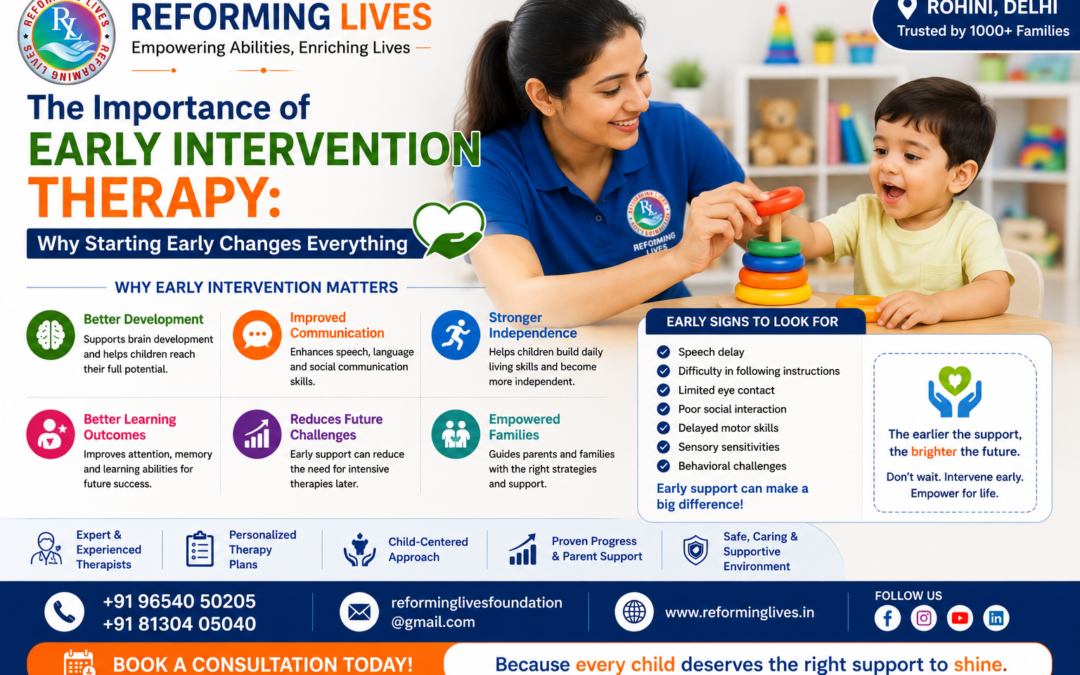
The Importance of Early Intervention Therapy: Why Starting Early Changes Everything
There is a window of opportunity in every child’s life that, once it closes, can never be fully reopened. Scientists call it the critical period of brain development. Parents who have lived through it with a child who received timely support call it a miracle window. And those who missed it often carry the weight of wondering — “What if we had started sooner?”
If your child has been diagnosed with a developmental condition — or if you simply have a feeling that your child’s development is not on track — please know this: the single most important thing you can do right now is act early.
Early Intervention Therapy is a structured set of specialised therapies and educational support provided to young children — typically between birth and age 5 — who have developmental delays or disabilities, or who are at significant risk of them. The evidence is overwhelming: early intervention works, and it works best the sooner it begins.
At Reforming Lives in Sector 16, Rohini, Delhi, our dedicated Early Intervention programme has been transforming the development of young children and the lives of their families since July 2016. This article explains exactly why early intervention is so important, what it involves, and how your child can benefit.
Understanding the First Five Years: Why They Matter So Much
At birth, a baby’s brain contains approximately 100 billion neurons. But most of the connections between those neurons — the neural pathways that determine how a child thinks, moves, communicates, and relates to the world — are formed in the first five years of life.
During this period, the brain is building connections at an extraordinary rate — up to one million new neural connections per second in the early months. This is what scientists mean when they say the young brain is “neuroplastic” — it is highly flexible, highly responsive, and highly capable of change.
When a child has a developmental delay or disability, these neural pathways do not form as efficiently on their own. But structured, targeted therapy during this critical window actively builds and strengthens those pathways in ways that become progressively harder to achieve after age 5.
In simple terms: the brain is most teachable before age 5. Therapy during these years produces the deepest, most lasting results.
What Is Early Intervention Therapy?
Early Intervention Therapy is not a single therapy — it is a coordinated package of services tailored to a young child’s specific developmental needs. At Reforming Lives, our Early Intervention programme draws on multiple disciplines working together:
- Speech and Language Therapy — building communication foundations early
- Occupational Therapy — developing fine motor, sensory, and daily living skills
- Physiotherapy — supporting physical movement, muscle tone, and motor development
- Sensory Integration Therapy — helping the nervous system process sensory input
- ABA Therapy — building communication, social, and learning skills through positive reinforcement
- Special Education — structured learning support within our Pre-Academic School
- Neuro Developmental Therapy (NDT) — addressing movement dysfunctions related to neurological conditions
- Parent Training and Guidance — equipping families to support development at home every day
The programme is always personalised — built around each child’s unique profile, strengths, and areas of need. At Reforming Lives, no two children follow exactly the same programme.
Conditions That Benefit Most from Early Intervention
Early intervention is particularly important for children with:
- Autism Spectrum Disorder (ASD) — research consistently shows that intensive early intervention leads to dramatically better outcomes in communication and social skills
- Global Developmental Delay — children who are behind across multiple developmental areas
- Speech and Language Delay — catching up on language before formal schooling begins
- Cerebral Palsy — building motor skills during the period when the brain can best adapt
- Down Syndrome — supporting cognitive, motor, and communication development from infancy
- Sensory Processing Disorder — regulating the nervous system before sensory challenges become entrenched patterns
- ADHD — building attention, impulse control, and learning strategies early
- Hearing Loss — supporting communication development as early as possible after identification
- At-risk premature infants — addressing developmental vulnerabilities before they become significant delays
The Real Benefits of Early Intervention Therapy
🟢 1. Faster and Greater Developmental Progress
Because the young brain is so adaptable, children who receive therapy during the early years make faster and more significant gains than those who start later. What takes months in a 3-year-old may take years in a 7-year-old — not because the child is less capable, but because the brain’s window of maximum flexibility has narrowed.
🟢 2. Reduced Severity of Challenges Over Time
Early intervention does not just speed up development — it can actually reduce the long-term severity of a child’s challenges. Children with autism who receive intensive early intervention often show significantly improved social communication. Children with cerebral palsy who receive early physiotherapy develop greater motor function than those who start later.
🟢 3. Better School Readiness
Children who receive early intervention are more likely to enter school with the communication, social, and learning skills they need. Many children who have received thorough early intervention at Reforming Lives have gone on to be successfully integrated into mainstream classrooms — a goal that would have been far more difficult to achieve without early support.
🟢 4. Prevention of Secondary Problems
Untreated developmental delays create a cascade of secondary problems — behaviour difficulties born of communication frustration, poor self-esteem from repeated failure, social isolation, and mental health challenges. Early intervention addresses the root causes before these secondary problems have a chance to develop.
🟢 5. Lifelong Benefits in Independence
Children who receive comprehensive early intervention consistently achieve greater long-term independence in daily life — in self-care, employment, relationships, and community participation. The investment made in those first five years pays dividends for an entire lifetime.
🟢 6. Empowered, Supported Families
Early intervention at Reforming Lives is not just for the child — it is for the whole family. Parents receive active training and support, giving them the knowledge, confidence, and strategies to make every interaction at home a therapeutic, developmental opportunity. Families feel less alone, less anxious, and more empowered.
Warning Signs That Should Not Be Ignored in Young Children
Seek an early intervention evaluation immediately if your child shows any of the following:
By 3 months:
- Not responding to loud sounds
- Not smiling at people
- Not following moving objects with their eyes
By 6 months:
- Not babbling or making vowel sounds
- Not reaching for objects
- No affectionate response to caregivers
By 12 months:
- No babbling
- No pointing or waving
- Not saying any words
- Not crawling
By 18 months:
- Not walking
- Not saying at least 10–15 words
- Not pointing to show interest
By 24 months:
- Not using two-word phrases
- Not imitating actions or words
- Loss of previously acquired skills at any age
Any loss of previously acquired skills — at any age — requires immediate professional attention.
The Reforming Lives Early Intervention Programme
When a family comes to Reforming Lives for early intervention, here is what they can expect:
Step 1 — Comprehensive Developmental Assessment Our team conducts a thorough, multi-disciplinary assessment of your child — covering motor skills, communication, cognition, sensory processing, behaviour, and daily living skills. We use standardised assessments alongside clinical observation to build a complete picture.
Step 2 — Individual Family Service Plan (IFSP) Based on the assessment, we create a detailed, personalised intervention plan with clear goals, timelines, and measurable outcomes — developed in full partnership with you.
Step 3 — Intensive, Coordinated Therapy Your child receives therapy sessions across multiple disciplines, all coordinated by our experienced team under the leadership of Dr. Subodh Kumar [PT] — MPT Neurology, BPT Jamia Hamdard, Certified in Sensory Integration and NDT.
Step 4 — Pre-Academic School Support Children in our early intervention programme can also benefit from our Pre-Academic School at Reforming Lives — a nurturing, inclusive classroom environment specifically designed for children with special needs.
Step 5 — Ongoing Parent Training You are your child’s primary therapist at home. We ensure you have the skills, knowledge, and confidence to support your child’s development every single day — not just during clinic hours.
Step 6 — Regular Reviews and Progress Monitoring Goals are reviewed regularly and updated as your child grows and progresses. We celebrate every milestone — because every milestone has been earned.
How Parents Can Support Early Intervention at Home
- Make every daily routine a learning opportunity — bathing, feeding, dressing are all rich developmental moments
- Talk, sing, and read to your child as much as possible, from infancy onwards
- Follow the home programme provided by your therapist team at Reforming Lives consistently
- Create a structured, predictable daily routine — young children with developmental delays thrive on consistency
- Respond to every communication attempt — a look, a sound, a gesture — as if it were a full conversation
- Connect with parent support groups — you are not alone, and community is healing
One Decision. A Lifetime of Difference.
At Reforming Lives, we are privileged to witness the most extraordinary transformations — babies who could not sit up learning to walk; non-verbal toddlers saying their first words; children who once screamed at every sensory input sitting calmly and happily in a classroom.
These are not miracles. They are the results of skilled, dedicated early intervention therapy — started at the right time, with the right team, and with parents who never stopped believing in their children.
You can give your child this chance. The time to act is now.
📞 Book an Early Intervention consultation at Reforming Lives today:
🏥 Reforming Lives — Children’s Rehabilitation & Therapy Centre 📍 Block I4/23-24-25, Sector 16, Rohini, Delhi 📱 Reception: +91 96540 50205 | Office: +91 8130405040 📧 reforminglivesfoundation@gmail.com 🌐 www.reforminglives.in
❓ Frequently Asked Questions (FAQs)
1. What age is considered “early” for early intervention therapy?
Early intervention is most powerful between birth and 5 years of age. However, beginning therapy before age 3 is especially beneficial due to the brain’s maximum neuroplasticity during this window. If your child is under 5 and showing developmental concerns, now is the ideal time to start.
2. How do I know if my child needs early intervention?
If your child is significantly behind developmental milestones in communication, motor skills, social interaction, or daily living skills, an early intervention assessment is recommended. You do not need a formal diagnosis to begin — concerns alone are sufficient reason to seek an evaluation.
3. What conditions does early intervention treat?
Early intervention supports children with autism, global developmental delay, speech delay, cerebral palsy, Down syndrome, sensory processing disorder, ADHD, hearing loss, and premature birth-related developmental risks, among others.
4. Is early intervention effective? Does it really work?
Yes. The evidence base for early intervention is very strong. Multiple studies show that children who receive early, intensive, coordinated therapy make significantly greater developmental gains than those who do not, particularly in communication, social skills, and independence.
5. What is the difference between early intervention and regular therapy?
Early intervention is specifically targeted at the developmental period before age 5 and is typically more intensive and comprehensive — involving multiple therapy disciplines working together with a coordinated family-centred plan. It is designed to address developmental needs during the most neurologically critical window.
6. Can early intervention help a child with autism attend a regular school?
Many children who receive comprehensive early intervention — including ABA therapy, speech therapy, OT, and special education — are subsequently able to integrate fully or partially into mainstream schooling. This is one of the key goals of our early intervention programme at Reforming Lives.
7. How do I access early intervention services at Reforming Lives?
Contact us at +91 96540 50205 or +91 8130405040, or email reforminglivesfoundation@gmail.com. You can also visit www.reforminglives.in to book a consultation. Our centre is at Block I4/23-24-25, Sector 16, Rohini, Delhi — serving families from Pitampura, Shalimar Bagh, Prashant Vihar, and all across Delhi NCR.