

Benefits of Speech Therapy for Children: A Complete Parent’s Guide
Communication is the most powerful tool a human being can have. It is how we express love, ask for help, share our thoughts, and build relationships. For children, the ability to communicate is not just a skill — it is the foundation of everything: learning, friendship, confidence, and emotional wellbeing.
But for thousands of children across India, communication does not come easily. Some struggle to produce sounds clearly. Others understand language well but cannot express themselves in words. Some have fluency problems like stuttering. Others have difficulty understanding and following what people say to them. All of these challenges — however big or small — can be transformed with the right professional support.
Speech therapy for children is one of the most impactful, evidence-based therapies available. At Reforming Lives in Sector 16, Rohini, Delhi, our dedicated Speech Therapy programme has helped hundreds of children find their voice and step into the world with confidence. In this article, we explain exactly what speech therapy involves, who benefits from it, and why starting early makes all the difference.
What Is Speech Therapy for Children?
Speech therapy, also known as Speech and Language Therapy (SLT), is a specialised intervention delivered by trained professionals called Speech-Language Pathologists or Speech Therapists. It addresses a wide range of communication difficulties, including:
- Articulation disorders — difficulty producing certain sounds correctly (e.g., saying “wabbit” instead of “rabbit”)
- Language disorders — difficulty understanding language (receptive) or expressing thoughts in words (expressive)
- Fluency disorders — stuttering or cluttering that disrupts the flow of speech
- Voice disorders — unusual pitch, quality, or loudness of voice
- Social communication difficulties — trouble using language appropriately in social situations
- Feeding and swallowing difficulties — oral motor challenges that also affect speech
- Augmentative and Alternative Communication (AAC) — supporting children who are non-verbal or minimally verbal using picture systems, sign language, or communication devices
Speech therapy is not simply about teaching children to “say words better.” It is about helping them understand the world through language and express themselves meaningfully — in whatever way works best for them.
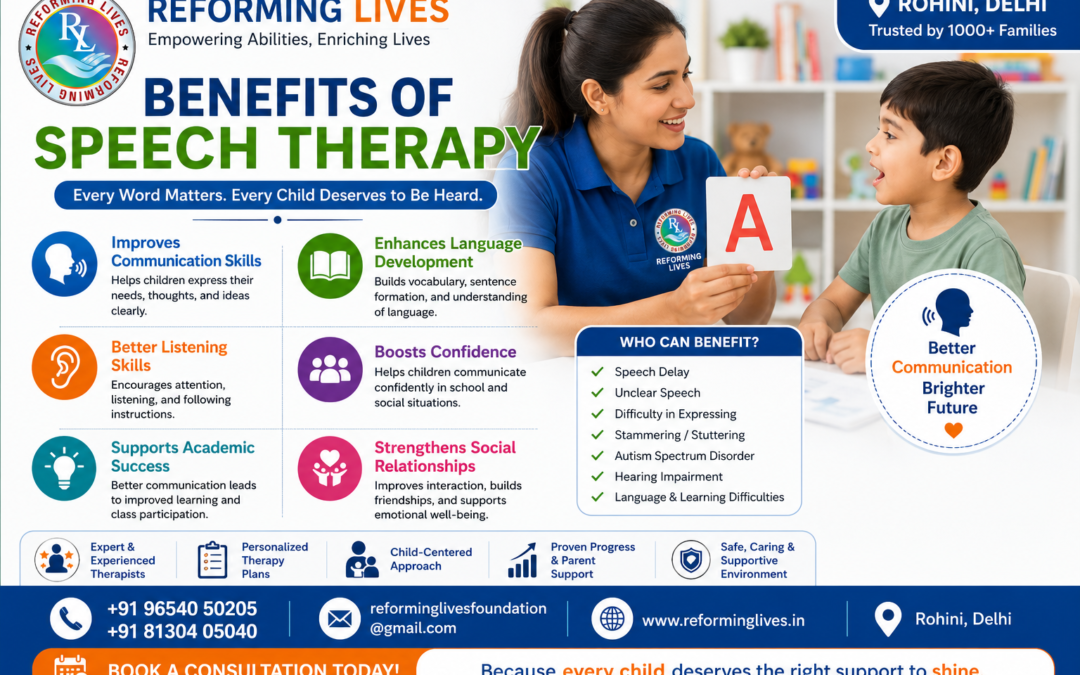
Who Needs Speech Therapy? Children Who Benefit Most
Speech therapy is beneficial for children with a wide range of diagnoses and challenges:
- Children with Autism Spectrum Disorder (ASD)
- Children with Speech Delay or Language Delay
- Children with ADHD who struggle with language organisation and social communication
- Children with Down Syndrome
- Children with Cerebral Palsy
- Children who stutter or stammer
- Children with hearing loss
- Children with Learning Disabilities who have reading and language processing difficulties
- Children who have had a neurological illness or injury
- Children with Cleft Palate or other structural differences
- Children who are late talkers without any identified diagnosis
- Children with Sensory Processing Disorder that affects communication
If your child struggles to communicate clearly at any level, a professional assessment at Reforming Lives will clarify exactly what support they need.
The Life-Changing Benefits of Speech Therapy for Children
Here is a detailed look at how speech therapy genuinely changes children’s lives:
🟢 1. Builds Clear and Confident Communication
The most immediate benefit of speech therapy is improvement in how clearly and confidently a child communicates. Whether a child was previously non-verbal, difficult to understand, or hesitant to speak, targeted therapy builds real, functional communication skills — in their own authentic way and at their own pace.
🟢 2. Reduces Frustration and Behaviour Problems
Many behaviour challenges in children — tantrums, aggression, withdrawal, meltdowns — are rooted in communication frustration. When a child cannot express what they need, they find other ways to make themselves understood. As speech therapy builds communication skills, frustration reduces — and with it, many difficult behaviours naturally decrease.
🟢 3. Supports Academic Success
Language is the foundation of all learning. Reading, writing, listening, and comprehension all depend on strong language skills. Children who receive speech therapy consistently show improvements in their ability to follow classroom instructions, participate in lessons, and develop literacy skills. At Reforming Lives, our speech therapists work in close coordination with our special educators to ensure that therapy directly supports school-readiness and academic progress.
🟢 4. Builds Social Skills and Friendships
Children who struggle to communicate often find it hard to make and keep friends. Speech therapy specifically addresses pragmatic language — the social rules of communication, like taking turns in conversation, staying on topic, reading social cues, and using appropriate tone and volume. As these skills develop, children become more able to build meaningful friendships.
🟢 5. Boosts Self-Esteem and Emotional Wellbeing
There is nothing quite like seeing a child who once felt embarrassed or unable to speak up begin to raise their hand in class, greet a friend, or tell their parent “I love you” for the first time. Speech therapy does not just build skills — it builds identity. Children begin to see themselves as capable, worthy communicators. The impact on confidence and emotional health is profound and lasting.
🟢 6. Supports Language Processing and Comprehension
At Reforming Lives, we offer a specialised Language Processing Therapy programme that targets children who struggle to understand, organise, and make sense of spoken language. This has a direct impact on a child’s ability to learn in school, follow instructions at home, and engage in meaningful conversation.
🟢 7. Helps Non-Verbal Children Communicate
Not all children who need speech therapy will develop verbal speech — and that is okay. Speech therapy includes AAC (Augmentative and Alternative Communication) approaches such as PECS (Picture Exchange Communication System), sign language, and communication devices. Every child deserves a voice — even if it is not spoken words. Our therapists at Reforming Lives are trained in AAC and are committed to finding the best communication system for every child.
🟢 8. Supports Feeding and Oral Motor Development
Many children, particularly those with cerebral palsy, Down syndrome, or neurological conditions, have difficulty with feeding — chewing, swallowing, or managing different food textures. Speech therapists are trained in oral motor therapy, which builds the muscle strength and coordination of the mouth, lips, and tongue — benefiting both speech production and safe eating.
🟢 9. Complements Other Therapies for Better Overall Outcomes
Speech therapy works best when combined with other interventions. At Reforming Lives, our multidisciplinary team integrates Speech Therapy with Occupational Therapy, Sensory Integration Therapy, ABA Therapy, Physiotherapy, and Special Education. This holistic, coordinated approach produces significantly better outcomes than any single therapy alone.
🟢 10. Empowers Parents as Communication Partners
One of the most valuable benefits of speech therapy at Reforming Lives is that we actively train parents. We teach you the techniques, strategies, and language tools your child’s therapist uses — so you can create a rich language environment at home, 24 hours a day. Parents who are actively involved in their child’s speech therapy programme consistently see faster, more durable results.
Signs Your Child May Need Speech Therapy
Do not wait for a formal diagnosis to seek speech therapy. If you notice any of the following, contact Reforming Lives for an assessment:
- Your child is not meeting speech milestones for their age
- Your child’s speech is very difficult to understand
- Your child stutters or gets stuck on words
- Your child avoids talking or becomes frustrated when trying to communicate
- Your child does not respond to their name or follow simple instructions
- Your child uses mostly gestures rather than words by age 2
- Your child’s teacher has raised concerns about their communication in school
Benefits of Starting Speech Therapy Early
The brain is at its most malleable in the first five years of life. Starting speech therapy during these critical years means:
- Faster progress due to greater neuroplasticity
- Prevention of secondary problems like poor literacy, low self-esteem, and behaviour difficulties
- Higher likelihood of reaching age-appropriate communication levels
- Better school readiness and academic outcomes
- Stronger social skills before peer comparison becomes emotionally painful
Every month matters. Do not wait for your child to “catch up on their own.”
Speech Therapy at Reforming Lives — What Parents Can Expect
When you bring your child to Reforming Lives for speech therapy, here is what the process looks like:
- Initial Consultation — Our team will speak with you about your concerns, your child’s developmental history, and what you are hoping to achieve
- Comprehensive Assessment — A structured evaluation of your child’s speech, language, comprehension, and communication profile
- Personalised Therapy Plan — A clear, goal-based plan designed specifically for your child
- Regular Therapy Sessions — One-on-one sessions in our warm, child-friendly therapy rooms
- Parent Guidance — You are always kept informed and actively involved
- Progress Reviews — Regular reviews to track goals and update the plan
- Coordination with Other Therapists — Our speech therapists work alongside our OT, physio, special education, and ABA teams for a seamless, holistic experience
Your Child’s Voice Is Waiting to Be Heard
Every child has something to say. Every child has a story, a need, a feeling that deserves to be expressed and understood. Speech therapy is not about fixing something broken — it is about building a bridge between your child’s inner world and the people who love them.
At Reforming Lives, we have been building those bridges since July 2016. We have seen non-verbal children communicate for the first time. We have heard children who once whispered speak up loudly and proudly. We have watched parents cry happy tears in our reception area.
Your child’s voice is in there. Let our team at Reforming Lives help bring it out.
📞 Book a Speech Therapy consultation today:
🏥 Reforming Lives — Children’s Rehabilitation & Therapy Centre 📍 Block I4/23-24-25, Sector 16, Rohini, Delhi 📱 Reception: +91 96540 50205 | Office: +91 8130405040 📧 reforminglivesfoundation@gmail.com 🌐 www.reforminglives.in
❓ Frequently Asked Questions (FAQs)
1. At what age should a child start speech therapy?
Speech therapy can begin as early as 12 months if concerns are identified. There is no minimum age. The earlier therapy begins, the better the outcomes, as the brain is most responsive to language learning in the first five years of life.
2. How many sessions of speech therapy does a child need?
This depends entirely on the child’s individual profile, the nature of their difficulty, and how consistently therapy is attended and practised at home. Some children need a few months; others benefit from longer-term support. Your therapist at Reforming Lives will give you a clear picture after the initial assessment.
3. Is speech therapy covered by insurance in India?
Coverage varies by insurance provider and policy. We recommend checking with your specific insurer. Our team at Reforming Lives can provide documentation to support any insurance claims you may need to make.
4. Can speech therapy help a child who is completely non-verbal?
Yes. Speech therapy for non-verbal children focuses on developing functional communication through AAC methods such as picture exchange systems, sign language, and communication devices — while also working towards speech development wherever possible.
5. Does speech therapy work for children with autism?
Yes, speech therapy is one of the most important therapies for children with autism. It addresses both verbal and non-verbal communication, social language use, and language processing — all of which are commonly affected in autism.
6. What is the difference between a speech delay and a language disorder?
A speech delay refers specifically to delayed development of spoken words and sounds. A language disorder is broader — it affects understanding and/or using language meaningfully. A child can have one or both, and a professional assessment will identify which applies to your child.
7. How can I book a speech therapy session at Reforming Lives in Rohini?
Call us at +91 96540 50205 or +91 8130405040, email us at reforminglivesfoundation@gmail.com, or visit www.reforminglives.in to book your first consultation. We welcome families from Rohini, Pitampura, Shalimar Bagh, and across Delhi NCR.