


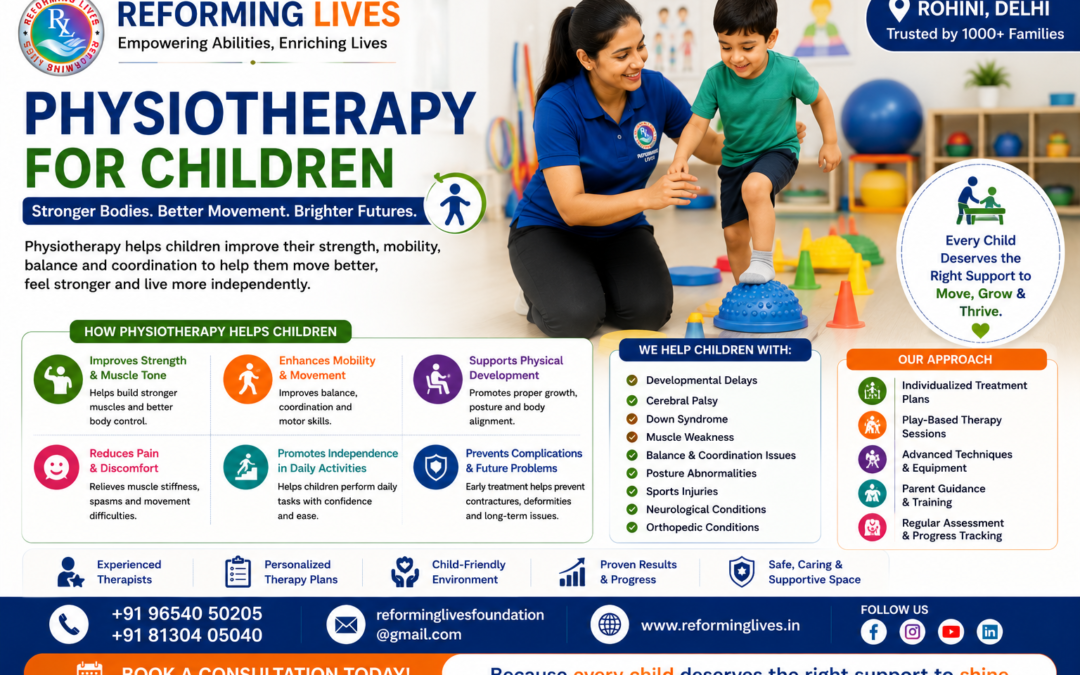
Physiotherapy for Children with Developmental Delays: What Every Parent Should Know
Every parent watches eagerly for the moment their baby first rolls over, sits up, crawls, stands, and takes that first wobbly, triumphant step. These milestones are not just precious moments — they are signposts of a child’s physical development, each one building the foundation for the next.
But what happens when those signposts are delayed? When a baby is not rolling by 6 months? When a toddler is not walking by 18 months? When a child runs differently from other children, falls frequently, or struggles with physical tasks that peers manage easily?
Developmental motor delays are more common than many parents realise — and paediatric physiotherapy is one of the most effective, evidence-based ways to address them. At Reforming Lives in Sector 16, Rohini, Delhi, our expert physiotherapy team has been helping children with developmental delays build strength, movement, and independence since July 2016.
This article explains everything Indian parents need to know about physiotherapy for children with developmental delays — what it is, who benefits, and how it can change your child’s physical journey.
What Is Paediatric Physiotherapy?
Paediatric physiotherapy (also called paediatric physical therapy) is a specialised branch of physiotherapy focused on assessing and treating movement and physical developmental difficulties in infants, children, and adolescents.
Unlike adult physiotherapy — which often focuses on injury recovery — paediatric physiotherapy is primarily focused on building developmental skills, maximising physical function, and supporting a child’s ability to move through the world as independently and comfortably as possible.
At Reforming Lives, our physiotherapy team works with children across a wide range of conditions and developmental profiles — always with a child-centred, family-involved approach.
Motor Development Milestones — What Is Typical?
Before identifying a delay, it helps to know what typical motor development looks like:
| Age | Gross Motor Milestones |
|---|---|
| 3 months | Holds head up during tummy time |
| 6 months | Rolls from tummy to back and back; sits with support |
| 9 months | Sits independently; begins to pull to stand |
| 12 months | Stands independently; takes first steps |
| 15 months | Walks independently |
| 18 months | Runs (though falls often); walks up stairs with support |
| 2 years | Runs confidently; jumps with both feet |
| 3 years | Climbs; pedals a tricycle; walks up and down stairs alternating feet |
| 4–5 years | Hops on one foot; catches a ball; skips |
Missing these milestones significantly — particularly multiple milestones — is a reason to seek a physiotherapy assessment promptly.
What Causes Developmental Motor Delays?
Motor delays can arise from a range of underlying conditions and circumstances:
- Premature birth — motor systems are often underdeveloped; premature babies benefit greatly from early physiotherapy
- Cerebral palsy — affecting motor control and muscle tone
- Down syndrome — low muscle tone (hypotonia) delays all motor milestones
- Global developmental delay — delays across all developmental areas
- Hypotonia (low muscle tone) — from various causes; affects physical development significantly
- Hypertonia (high muscle tone) — muscle stiffness limiting movement range
- Spina bifida — affecting lower limb function
- Muscular dystrophy — progressive muscle weakness
- Neurological conditions — brain injuries, metabolic disorders
- Orthopaedic conditions — joint or bone issues affecting movement
- Idiopathic delay — delayed motor development without a clearly identified cause
How Developmental Motor Delays Affect Children
Untreated or unsupported motor delays do not simply affect physical movement — they ripple through a child’s entire development:
- Cognitive development is closely linked to physical exploration — children learn about the world by moving through it
- Language development is supported by movement and play
- Social development is affected when a child cannot keep up physically with peers
- Confidence and self-esteem suffer when a child sees their limitations relative to other children
- Secondary physical complications — contractures, postural deformities, joint problems — can develop if motor challenges are not addressed
Early physiotherapy prevents many of these secondary consequences and gives children the best possible physical foundation.
How Physiotherapy Helps Children with Developmental Delays
Paediatric physiotherapy addresses motor delays through a carefully tailored programme of assessment, treatment, and exercise. At Reforming Lives, our physiotherapy programme includes:
🟢 Comprehensive Motor Assessment
Our physiotherapists conduct a thorough evaluation of your child’s current motor abilities — strength, muscle tone, range of movement, balance, coordination, and developmental milestone achievement. This forms the basis of a personalised treatment plan.
🟢 Strength and Muscle Tone Treatment
Whether your child has hypotonia (low tone) or hypertonia (high tone), our physiotherapists use targeted techniques to bring muscle function closer to the optimal range for movement:
- Strengthening exercises for hypotonic children — building core stability, limb strength, and postural control
- Stretching and positioning for hypertonic children — reducing stiffness and improving movement range
- Functional strength activities embedded in play — children are more motivated and engaged when therapy feels like fun
🟢 Gross Motor Skill Development
Our physiotherapists work systematically through motor milestones — building each skill on the foundation of the previous one:
- Head control and neck strengthening
- Rolling and transitional movements
- Sitting balance and stability
- Crawling — an important developmental stage with cognitive as well as physical benefits
- Pulling to stand and cruising
- Independent standing and walking
- Running, jumping, climbing, and advanced gross motor skills
🟢 Neuro Developmental Therapy (NDT)
At Reforming Lives, our Neuro Developmental Therapy programme — led by Dr. Subodh Kumar [PT] (MPT Neurology, NDT certified) — uses specialised hands-on techniques to improve the quality of movement in children with neurological conditions affecting motor development. NDT addresses abnormal movement patterns, improving postural control and functional motor skills.
🟢 Balance and Coordination Training
Many children with developmental delays have significant balance and coordination difficulties. Our physiotherapists use structured activities and equipment to build these skills progressively and safely.
🟢 Gait Training
Children with motor delays often develop compensatory or inefficient walking patterns. Our physiotherapists work on gait correction — improving the quality, safety, and efficiency of your child’s walking pattern.
🟢 Postural Management
Proper positioning and posture throughout the day is critical for children with motor delays. Our team advises on:
- Optimal positioning during sleep, sitting, standing, and play
- Supportive equipment where appropriate
- How to handle and carry your child in ways that support (rather than hinder) motor development
🟢 Home Exercise Programme
At Reforming Lives, we place enormous emphasis on the home exercise programme. Therapy sessions alone are not enough — daily practice at home is what drives meaningful, lasting progress. Our physiotherapists teach parents the exercises and handling techniques so that your child’s physiotherapy continues at home every single day.
Signs That Your Child May Need Physiotherapy
Seek a physiotherapy assessment if your child:
- Is significantly behind motor milestones for their age
- Has unusually floppy muscles (hypotonia) or appears very stiff
- Walks on tip-toes without a medical reason
- Falls much more frequently than other children the same age
- Has an unusual or asymmetrical walking pattern
- Strongly prefers one side of their body — rarely using one arm or leg
- Is very clumsy — constantly bumping into things, dropping objects
- Has difficulty with stairs, running, or jumping well beyond the typical developmental delay
- Has a diagnosed condition like cerebral palsy, Down syndrome, or spina bifida
The Reforming Lives Physiotherapy Advantage
When families choose Reforming Lives for their child’s physiotherapy in Rohini, they benefit from:
- Expert clinical leadership — Dr. Subodh Kumar [PT] holds MPT in Neurology, BPT from Jamia Hamdard, and holds NDT and Sensory Integration certifications; Dr. Ravi holds BPT, MPT Neurology, and MDCPT
- Holistic, multi-disciplinary approach — physiotherapy at Reforming Lives is seamlessly integrated with Occupational Therapy, Speech Therapy, Sensory Integration, and Special Education
- Child-centred, play-based therapy — our therapists make every session engaging and motivating for children
- Active parent partnership — you are trained and involved at every step
- Convenient Rohini location — easily accessible from Pitampura, Prashant Vihar, Shalimar Bagh, Mangolpuri, and across North and West Delhi
Your Child Is Built to Move — Let Us Help Them Get There
Every child is born with the potential to move, to explore, and to discover the world through their body. When a developmental delay gets in the way of that potential, physiotherapy is the expert hand that guides the child forward — with skill, with patience, and with genuine care.
At Reforming Lives, we are proud to have helped hundreds of children in Rohini and across Delhi NCR take their first steps — literally and figuratively. Every step forward, every milestone reached, every child who moves more freely than they did before — this is why we do what we do.
Your child’s movement journey starts here. Contact Reforming Lives today.
📞 Book a paediatric physiotherapy consultation:
🏥 Reforming Lives — Children’s Rehabilitation & Therapy Centre 📍 Block I4/23-24-25, Sector 16, Rohini, Delhi 📱 Reception: +91 96540 50205 | Office: +91 8130405040 📧 reforminglivesfoundation@gmail.com 🌐 www.reforminglives.in
❓ Frequently Asked Questions (FAQs)
1. At what age can a child start physiotherapy?
Paediatric physiotherapy can begin from birth — or even before birth in high-risk cases. The earlier physiotherapy starts for a child with motor delays or a condition like CP or Down syndrome, the better the outcomes. There is no minimum age for starting.
2. How often should a child with developmental delays attend physiotherapy?
This depends on the severity of the delay and the child’s specific goals. Many children benefit from 2–3 physiotherapy sessions per week, supplemented by a daily home exercise programme. Your physiotherapist at Reforming Lives will recommend the right frequency for your child.
3. Is physiotherapy painful for children?
Good paediatric physiotherapy is not painful. Our therapists at Reforming Lives use child-friendly, play-based techniques that make sessions engaging and enjoyable. There may be some effort involved in exercises, but therapy should never cause significant pain.
4. Will my child with developmental delays catch up to their peers with physiotherapy?
Many children with developmental motor delays do catch up to typical developmental levels with consistent physiotherapy, particularly when therapy begins early. Others make significant progress without fully closing the gap. The goal is always to maximise each child’s individual potential.
5. Can physiotherapy help a child who walks on their tiptoes?
Yes. Toe-walking (without a medical cause) can be addressed effectively through physiotherapy, which works on calf muscle flexibility, balance, and correcting the walking pattern. Our physiotherapists will assess whether the toe-walking has an underlying neurological cause and design treatment accordingly.
6. What is the difference between physiotherapy and occupational therapy for children?
Physiotherapy focuses primarily on gross motor skills — large muscle movements, walking, balance, posture, and physical strength. Occupational Therapy focuses on daily function — fine motor skills, sensory processing, self-care, and school-readiness. Both are offered at Reforming Lives and frequently complement each other.
7. How do I book a physiotherapy appointment at Reforming Lives in Rohini?
Call +91 96540 50205 (Reception) or +91 8130405040 (Office), or email reforminglivesfoundation@gmail.com. Visit www.reforminglives.in to book online. We are at Block I4/23-24-25, Sector 16, Rohini, Delhi — serving families from Pitampura, Prashant Vihar, Shalimar Bagh, and across Delhi NCR.