


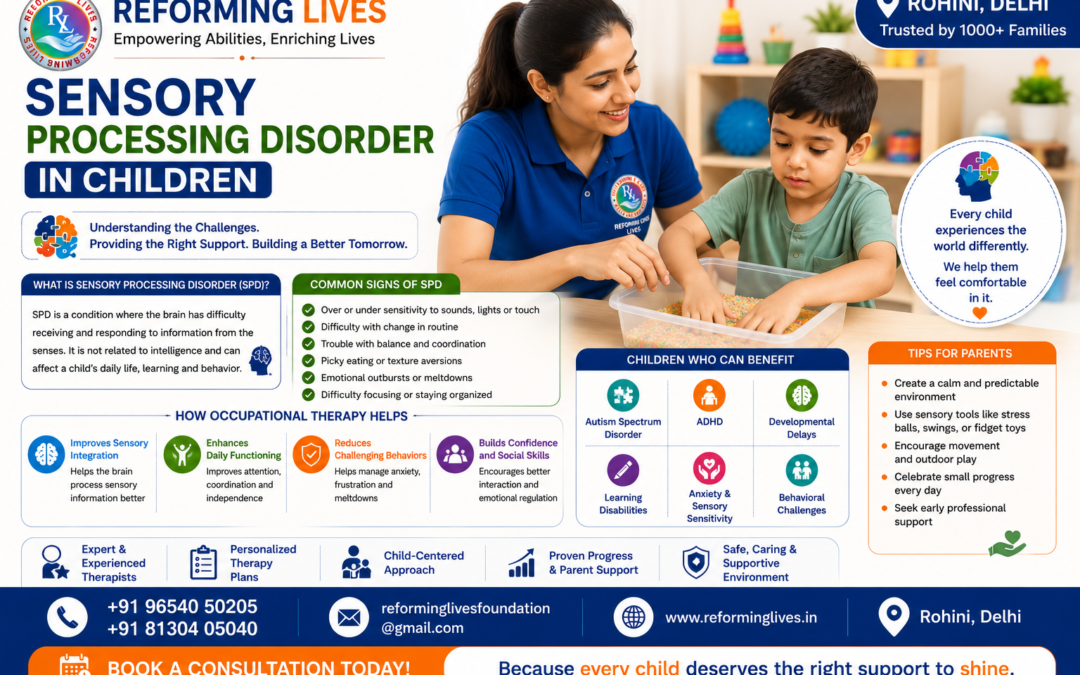
Sensory Processing Disorder in Children: A Complete Guide for Parents
Some children flinch when you hug them. Some cannot bear the feel of socks on their feet. Some cover their ears and scream at sounds you barely notice. Some spin endlessly, crash into furniture, or chew everything they can find. And some are so sensitive to bright lights or busy rooms that a simple trip to the market becomes a full-scale meltdown.
If this sounds like your child, you are not dealing with a naughty child or a parenting problem. You may be dealing with Sensory Processing Disorder (SPD) — a condition that affects how the brain receives, interprets, and responds to sensory information from the body and the environment.
SPD is one of the most misunderstood conditions in children — dismissed by well-meaning relatives as “over-sensitivity” or “drama,” when in reality your child is experiencing sensory input very differently from most people. The world can feel genuinely overwhelming, even painful, for children with SPD.
At Reforming Lives in Sector 16, Rohini, Delhi, our dedicated Sensory Integration Therapy programme has helped hundreds of children become more comfortable in their own skin and in the world around them. This guide explains everything Indian parents need to know about SPD.
What Is Sensory Processing Disorder?
Our bodies are constantly receiving information through our senses — sight, sound, touch, taste, smell, movement, and body awareness. In most people, the brain processes all this information efficiently and generates appropriate responses.
In children with Sensory Processing Disorder, the brain struggles to organise and respond to this sensory information in a typical way. The result is that sensory input that most people barely notice can feel overwhelming, distressing, or even physically painful — or, in other cases, barely noticed at all.
SPD is not a behaviour problem. It is a neurological processing difference. The child is not choosing to overreact. Their nervous system is genuinely responding differently to sensory input.
SPD can occur on its own, but it is also very commonly seen alongside autism spectrum disorder, ADHD, developmental delays, and learning disabilities.
The Eight Senses — Yes, Eight
Most of us learned about five senses in school. But the human sensory system actually has eight senses relevant to SPD:
- Visual — sight and visual information processing
- Auditory — hearing and sound processing
- Tactile — touch, temperature, pain
- Gustatory — taste
- Olfactory — smell
- Vestibular — movement and balance (processed in the inner ear)
- Proprioception — body position and awareness (felt through muscles and joints)
- Interoception — internal body signals (hunger, thirst, heartbeat, pain)
SPD can affect any or all of these senses, in different directions — either over-responsive (hypersensitive) or under-responsive (hyposensitive).
Types of Sensory Processing Disorder
🔴 Type 1: Sensory Modulation Disorder
The child has difficulty regulating their responses to sensory input. This appears in three patterns:
Sensory Over-Responsivity (Hypersensitivity) The child reacts too strongly to sensory input that most people would barely notice:
- Extreme distress at light touch, certain clothing textures, or haircuts
- Covering ears at moderate sounds — vacuum cleaners, crowded places, even applause
- Gagging at certain food textures or smells
- Distressed by unexpected touch
- Avoidance of messy play, sand, or certain surfaces
Sensory Under-Responsivity (Hyposensitivity) The child seems barely aware of sensory input — appearing sluggish, slow to respond, or seemingly not noticing pain or discomfort:
- Not responding to being called
- Not noticing food on their face
- Under-reacting to pain — may not notice an injury
- Appearing lethargic and hard to engage
Sensory Seeking/Craving The child constantly seeks intense sensory stimulation:
- Crashing into furniture, jumping off high surfaces
- Spinning constantly and never getting dizzy
- Chewing everything — clothing, pencils, their own hands
- Touching every surface and every person they encounter
- Needing very loud sounds or very bright stimulation
🔴 Type 2: Sensory-Based Motor Disorder
Affects body posture and coordination — the child may be noticeably clumsy, have poor balance, or struggle with coordinated movement.
🔴 Type 3: Sensory Discrimination Disorder
Difficulty distinguishing between sensory inputs — telling apart similar sounds, similar textures, or determining where on the body they are being touched.
Signs of Sensory Processing Disorder in Children — A Checklist
Tactile (Touch) Signs:
- Overreacts to light touch — flinches, pulls away
- Cannot tolerate clothing tags, seams, or certain fabrics
- Refuses to walk barefoot on grass, sand, or carpet
- Avoids messy play — paint, glue, clay, sand
- Dislikes having face or hair touched
- Distressed by haircuts or nail trimming
Auditory (Sound) Signs:
- Covers ears at everyday sounds
- Extremely distressed by loud environments like malls or parties
- Appears not to hear when called
- Easily startled by sounds
Visual (Sight) Signs:
- Distressed by bright lights or sunlight
- Fascinated by lights, spinning objects, or visual patterns
- Easily visually distracted or overwhelmed
Movement Signs:
- Craves spinning, swinging, jumping, or crashing
- OR is extremely fearful of movement — avoids swings, slides, stairs
- Clumsy, frequently bumps into things or falls
- Difficulty with balance
Taste and Smell Signs:
- Very limited diet — refuses most food textures or flavours
- Gags or vomits at certain food smells or textures
- Puts non-food items in mouth frequently (pica)
- OR under-sensitive — puts very spicy or extreme flavours in mouth without reaction
Body Awareness Signs:
- Writes with extreme pressure (breaking pencils) or almost no pressure
- Stands very close to others — invades personal space
- Seems unaware of own strength — hits/hugs too hard
- Poor awareness of own body position
If your child shows multiple signs from this checklist, an assessment at Reforming Lives is strongly recommended.
What Causes Sensory Processing Disorder?
The exact causes of SPD are not yet fully understood, but research points to:
- Neurological differences in how the brain processes and integrates sensory signals
- Genetic factors — SPD tends to run in families
- Premature birth — the sensory system is often underdeveloped in premature babies
- Prenatal stress or complications
- Trauma or neglect in early childhood affecting neurological development
SPD is not caused by bad parenting. It is not a behavioural choice. It is a neurological reality.
How Sensory Processing Disorder Affects Daily Life
For children with SPD, everyday activities that most children manage effortlessly can be genuinely challenging:
- Getting dressed — the feel of certain clothes can cause real distress every morning
- Mealtimes — food texture aversions can make eating an incredibly limited, stressful experience
- School — noisy classrooms, fluorescent lights, physical contact with peers can be overwhelming
- Social situations — birthday parties, markets, family gatherings can trigger meltdowns
- Haircuts and hygiene — these routine self-care tasks can be genuinely traumatic for sensory-sensitive children
- Sleep — sensory sensitivities often disrupt the ability to settle and sleep well
For families, this creates an exhausting daily landscape of battles, avoidances, and meltdowns that others simply do not understand.
Sensory Integration Therapy at Reforming Lives
The gold standard treatment for SPD is Sensory Integration Therapy (SIT) — a specialised form of Occupational Therapy developed to help the nervous system learn to process sensory information more efficiently.
At Reforming Lives, our Sensory Integration Therapy programme is one of our most established services, delivered by our expert therapy team led by Dr. Subodh Kumar [PT] — who holds certification in Sensory Integration and Neuro Developmental Therapy (C-SI/NDT).
Our Sensory Integration Therapy involves:
🟢 Sensory Assessment
A thorough evaluation of your child’s sensory profile — identifying which senses are over-responsive, under-responsive, or seeking, and how this affects daily function.
🟢 Personalised Sensory Integration Programme
Using carefully graded, playful sensory activities in our well-equipped therapy environment, our therapists progressively challenge and strengthen your child’s sensory processing abilities — in a safe, controlled, enjoyable way.
🟢 Sensory Diet
A personalised plan of sensory activities to be carried out throughout the day at home — maintaining your child’s sensory regulation between therapy sessions.
🟢 Environmental Modifications
Our team advises on modifications to your home and school environment that reduce unnecessary sensory challenges and increase your child’s comfort and focus.
🟢 Parent and Teacher Training
We train both parents and teachers in how to recognise and respond to your child’s sensory needs — creating consistency between home, therapy, and school.
🟢 Integration with Other Therapies
SPD rarely exists alone. Our Sensory Integration Therapy at Reforming Lives is coordinated with Speech Therapy, OT, ABA Therapy, and Special Education — addressing the whole child, not just one aspect.
What Parents Can Do at Home
- Implement the sensory diet provided by your therapist consistently
- Offer deep pressure activities — firm hugs, weighted blankets, carrying heavy objects
- Provide movement opportunities throughout the day — swinging, bouncing, climbing
- Create a calm sensory corner at home — a quiet, low-stimulation retreat space
- Introduce new foods gradually and without pressure — repeated, low-pressure exposure over time
- Use soft, seamless clothing where possible; let your child choose what feels comfortable
- Warn your child before touch — “I’m going to pick you up now” prevents startling
- Celebrate tolerance — when your child manages a difficult sensory situation calmly, celebrate it genuinely
Your Child Deserves a Comfortable World
Children with SPD are not difficult. They are not dramatic. They are not manipulative. They are navigating a world that feels genuinely different — and often genuinely overwhelming — to them. With the right therapy and the right understanding, the world becomes a far more manageable, comfortable, and enjoyable place.
At Reforming Lives, we have watched sensory-sensitive children transform from children who screamed at every unexpected touch to children who play comfortably with peers. We have helped children who could only eat three foods expand their diets. We have helped children who could not enter a classroom without meltdowns sit calmly and learn.
Your child can get there too. Let us help.
📞 Contact Reforming Lives today:
🏥 Reforming Lives — Children’s Rehabilitation & Therapy Centre 📍 Block I4/23-24-25, Sector 16, Rohini, Delhi 📱 Reception: +91 96540 50205 | Office: +91 8130405040 📧 reforminglivesfoundation@gmail.com 🌐 www.reforminglives.in
❓ Frequently Asked Questions (FAQs)
1. Is sensory processing disorder the same as autism?
No, they are different conditions — though they often co-exist. Many children with autism also have sensory processing difficulties, but not all children with SPD have autism. SPD can occur entirely independently of autism. A professional evaluation at Reforming Lives will clarify which conditions your child has.
2. Can sensory processing disorder be cured?
SPD is not typically described as something that is “cured,” but with consistent Sensory Integration Therapy, most children show significant improvement in how they process and respond to sensory input — making daily life much more comfortable and manageable. Many children make remarkable gains with the right therapy.
3. At what age can sensory processing disorder be identified?
Signs of SPD can be observed from infancy — unusual responses to being held, bathed, or fed. Most children are identified between ages 2 and 7, but SPD can be identified and addressed at any age. Earlier identification and therapy always leads to better outcomes.
4. Does my child with SPD need occupational therapy or sensory integration therapy — what’s the difference?
Sensory Integration Therapy is actually a specialised type of Occupational Therapy. At Reforming Lives, our OT team includes therapists certified in Sensory Integration, so your child receives both OT and sensory integration expertise as part of a unified programme.
5. My child only eats 4–5 foods. Is this related to SPD?
Extreme food selectivity is one of the most common presentations of sensory processing difficulties, particularly tactile and gustatory sensitivity. Feeding therapy — a specialised area of OT and speech therapy — addresses this systematically and compassionately. Our team at Reforming Lives can help.
6. How is a sensory diet different from a food diet?
A sensory diet has nothing to do with food! It is a personalised plan of sensory activities — movement breaks, deep pressure activities, tactile play — designed to give your child’s nervous system the right type and amount of sensory input throughout the day, keeping them regulated and focused.
7. How do I book a Sensory Integration Therapy assessment at Reforming Lives?
Call +91 96540 50205 or +91 8130405040, or email reforminglivesfoundation@gmail.com. You can also visit www.reforminglives.in to book online. We are at Block I4/23-24-25, Sector 16, Rohini, Delhi — serving families from Pitampura, Shalimar Bagh, Paschim Vihar, and across Delhi NCR.