


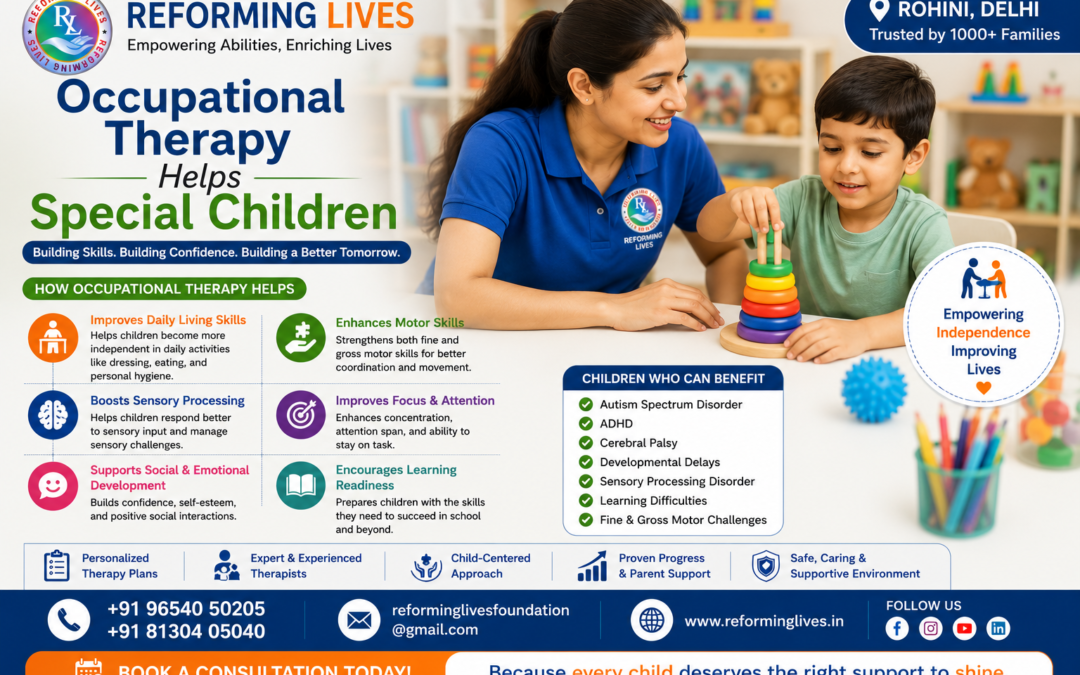
How Occupational Therapy Helps Special Children: Everything Parents Need to Know
Imagine not being able to hold a pencil, button your shirt, or sit at a table without feeling overwhelmed. Imagine that the texture of your socks feels unbearable, that the noise in a classroom feels like physical pain, or that your hands just will not cooperate with what your brain is trying to tell them to do.
For many children with developmental disorders, neurological conditions, or sensory processing difficulties, this is daily life. These are not small inconveniences — they are real, significant challenges that affect a child’s ability to learn, play, and grow. And this is exactly where Occupational Therapy becomes a game-changer.
At Reforming Lives in Sector 16, Rohini, Delhi, Occupational Therapy (OT) is one of our most transformative services. Our experienced Occupational Therapists work with children across a wide range of conditions to build the skills they need for a more independent, confident, and comfortable life.
What Is Occupational Therapy for Children?
The word “occupation” in Occupational Therapy does not refer to jobs or careers. For children, “occupations” are the activities that make up their daily life — playing, learning, eating, dressing, writing, socialising, and self-care.
Occupational Therapy (OT) is a specialised healthcare service that helps children develop, recover, or maintain the skills needed to perform these daily activities as independently as possible. An Occupational Therapist assesses where a child is struggling, identifies the underlying reasons, and uses targeted, evidence-based techniques to build those missing skills.
OT addresses challenges across three main areas:
- Physical skills — fine motor coordination, hand strength, balance, body awareness
- Cognitive skills — attention, organisation, problem-solving, following instructions
- Sensory processing — how the brain interprets and responds to sensory information from the environment
Which Children Benefit from Occupational Therapy?
Occupational Therapy is beneficial for children with a wide range of conditions, including:
- Autism Spectrum Disorder (ASD) — sensory regulation, daily living skills, social participation
- ADHD — attention, organisation, fine motor skills, emotional regulation
- Cerebral Palsy — movement, muscle tone, daily function, adaptive techniques
- Down Syndrome — fine motor development, daily independence, learning skills
- Developmental Delay — building age-appropriate daily living skills
- Sensory Processing Disorder — managing sensory sensitivities and seeking behaviours
- Learning Disabilities — handwriting, visual perception, reading and writing foundations
- Premature Birth — catching up on motor and developmental milestones
- Neurological conditions — rebuilding function after neurological injury or illness
If your child struggles with any daily task that other children their age manage more easily, an OT assessment at Reforming Lives can identify exactly where the challenges lie and how to address them.
Key Areas Occupational Therapy Addresses
🟢 1. Fine Motor Skills Development
Fine motor skills involve the small muscles of the hands and fingers used for writing, cutting, drawing, buttoning clothes, using cutlery, and manipulating small objects. Many children with developmental conditions struggle significantly in this area.
Our OT team uses hands-on, playful activities to build hand strength, dexterity, and coordination — making tasks like holding a pencil, doing up buttons, and using scissors much more manageable.
🟢 2. Sensory Processing and Regulation
One of the most important and specialised areas of OT is sensory processing. Many children with autism, ADHD, and sensory processing disorder are either oversensitive (finding certain sounds, textures, or lights unbearable) or undersensitive (constantly seeking intense sensory input like spinning, crashing, or chewing).
At Reforming Lives, our Sensory Integration Therapy — a specialised branch of OT — helps children’s nervous systems learn to process sensory information more effectively. This leads to reduced meltdowns, better focus, and a calmer, more regulated child.
🟢 3. Activities of Daily Living (ADL)
Teaching children to manage their own self-care is one of OT’s most empowering contributions. Our therapists work on skills like:
- Dressing and undressing independently
- Feeding and using cutlery appropriately
- Toileting and personal hygiene
- Organising their school bag and belongings
- Managing a simple daily routine
Building these skills increases a child’s independence and self-esteem enormously — and gives parents a much-needed break.
🟢 4. School Readiness and Handwriting
Many children referred to Reforming Lives for OT are struggling in school — not because they are unintelligent, but because they lack the foundational skills that school demands. OT builds:
- Pencil grip and handwriting — helping children write comfortably and legibly
- Visual perception — the ability to distinguish between letters, read with accuracy, and copy from a board
- Sitting tolerance — building the ability to sit attentively at a desk for learning
- Following multi-step instructions — an executive function skill critical for classroom success
🟢 5. Play Skills and Social Participation
Play is a child’s most important “occupation.” Through play, children learn about the world, develop language, and build social skills. OT helps children who struggle with imaginative play, turn-taking, sharing, and engaging with peers — building the foundations for meaningful social relationships.
🟢 6. Emotional Regulation
Many children with developmental differences struggle to manage their emotions. OT gives children practical, sensory-based tools to self-regulate — to recognise when they are getting overwhelmed and use strategies to bring themselves back to a calm, ready-to-learn state.
🟢 7. Eye-Hand Coordination
At Reforming Lives, we offer a dedicated Eye-Hand Coordination programme as part of our OT services. This builds the crucial connection between what the eyes see and what the hands do — impacting everything from catching a ball to reading, writing, and using a computer.
Signs Your Child May Need Occupational Therapy
Watch for these signs that suggest OT assessment would be beneficial:
- Avoids messy play, certain food textures, or physical contact
- Has a very weak or unusual pencil grip; handwriting is very poor
- Gets overwhelmed and distressed in busy or noisy environments
- Has difficulty dressing, using cutlery, or managing personal care
- Cannot sit still for age-appropriate periods
- Is clumsy — bumps into things, drops objects, falls frequently
- Has poor body awareness — does not know where their body is in space
- Gets extremely upset by routine changes or transitions
- Struggles to organise themselves and their belongings
- Has meltdowns that seem out of proportion to the situation
How Occupational Therapy Works at Reforming Lives
At Reforming Lives, our OT programme follows a structured, child-centred process:
- Comprehensive OT Assessment — evaluating fine motor, sensory, visual, and daily living skills
- Personalised OT Plan — specific, measurable goals set in collaboration with parents
- Individual Therapy Sessions — engaging, play-based sessions in our well-equipped therapy environment
- Sensory Diet — a personalised programme of sensory activities for your child to do throughout the day
- Parent Training — you learn the same strategies so therapy continues at home
- School Liaison — we advise schools on adjustments that support your child in the classroom
- Regular Progress Reviews — goals are reviewed and updated as your child progresses
Our OT team works in close coordination with our Speech Therapists, Physiotherapists, ABA Therapists, and Special Educators — ensuring every aspect of your child’s development is addressed together.
How Parents Can Support OT at Home
- Encourage your child to do daily tasks by themselves — even if it takes longer
- Provide sensory-friendly environments at home — manage lighting, noise, and texture where possible
- Incorporate sensory play — sand, water, clay, playdough are all excellent at home
- Follow the sensory diet provided by your OT therapist consistently
- Use visual schedules to help your child anticipate and manage daily routines
- Allow movement breaks — children who need sensory input regulate better with regular physical activity
- Praise effort and independence — “I’m so proud you tried to button that yourself!”
Building Independence, One Skill at a Time
At Reforming Lives, we believe deeply that every child — regardless of diagnosis — deserves the opportunity to be as independent, capable, and comfortable as possible. Occupational Therapy is the discipline that makes that vision real, one carefully chosen activity at a time.
We have been working with families across Rohini, Pitampura, Shalimar Bagh, Prashant Vihar, and wider Delhi NCR since 2016, and the transformations we have witnessed — a child using a fork independently for the first time, a sensory-sensitive child sitting calmly in a busy classroom, a child writing their own name — never stop moving us.
Your child can get there. Let our OT team at Reforming Lives show you the way.
📞 Contact us to book an Occupational Therapy assessment:
🏥 Reforming Lives — Children’s Rehabilitation & Therapy Centre 📍 Block I4/23-24-25, Sector 16, Rohini, Delhi 📱 Reception: +91 96540 50205 | Office: +91 8130405040 📧 reforminglivesfoundation@gmail.com 🌐 www.reforminglives.in
❓ Frequently Asked Questions (FAQs)
1. What does an occupational therapist do for children?
An occupational therapist helps children develop the physical, cognitive, and sensory skills needed for daily activities like dressing, writing, playing, and participating in school. They assess where a child is struggling and use evidence-based, play-based techniques to build those specific skills.
2. How is occupational therapy different from physiotherapy?
Physiotherapy focuses primarily on improving large muscle movement, physical strength, balance, and mobility. Occupational Therapy focuses on helping children perform daily activities and occupations — including fine motor skills, sensory processing, self-care, and school-readiness skills. Both are offered at Reforming Lives, and they often complement each other.
3. Can occupational therapy help children with autism?
Absolutely. OT is one of the most important therapies for children with autism. It addresses sensory processing difficulties, daily living skills, fine motor coordination, and social participation — all of which are commonly affected by autism.
4. How long does occupational therapy take?
The duration depends on your child’s specific challenges and goals. Some children make their key gains within 6–12 months; others benefit from longer-term OT support. Your therapist at Reforming Lives will give you a clear, realistic picture after the initial assessment.
5. What is a sensory diet in occupational therapy?
A sensory diet is a personalised plan of sensory activities designed to give your child the specific type and amount of sensory input their nervous system needs throughout the day. It is created by your OT therapist and is meant to be carried out at home, helping your child stay regulated and focused.
6. At what age can children start occupational therapy?
OT can begin in infancy and is especially valuable in the early childhood years (0–6). However, OT is beneficial at any age. If your child is struggling with daily tasks or sensory challenges at any point in childhood, it is worth seeking an OT assessment.
7. How do I book an OT session at Reforming Lives in Rohini?
Simply call us at +91 96540 50205 or +91 8130405040, email reforminglivesfoundation@gmail.com, or visit www.reforminglives.in. We are at Block I4/23-24-25, Sector 16, Rohini, Delhi, and welcome families from across North Delhi and Delhi NCR.