


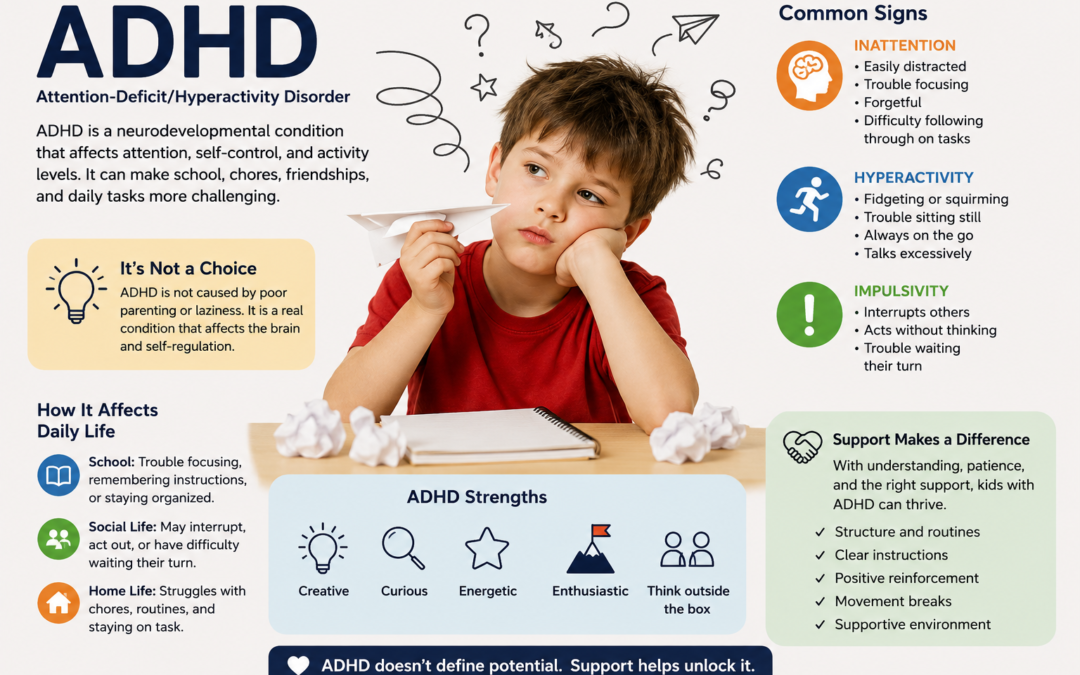
What is ADHD in Children? Everything Indian Parents Need to Know
Every classroom has that one child — the one who can’t sit still, loses their pencil box every single day, blurts out answers before the teacher finishes the question, and forgets homework even when they wrote it down. Teachers call them “careless.” Relatives call them “naughty.” And parents, exhausted and confused, quietly wonder — is something more going on with my child?
If this sounds like your child, you may be dealing with ADHD — Attention Deficit Hyperactivity Disorder. It is one of the most common neurodevelopmental conditions in children worldwide, yet in India, it remains widely misunderstood, underdiagnosed, and often dismissed as poor parenting or bad behaviour.
The truth is, ADHD is a real brain-based condition — and with the right understanding, the right therapy, and the right support, children with ADHD can absolutely thrive. This guide will help you understand exactly what ADHD is, what signs to watch for, and how expert therapy at Reforming Lives in Rohini, Delhi can make a life-changing difference for your child.
What Exactly Is ADHD? Understanding It in Simple Language
ADHD stands for Attention Deficit Hyperactivity Disorder. It is a condition that affects how the brain manages attention, impulse control, and activity levels. Children with ADHD are not being deliberately disobedient — their brains are literally wired differently, making it genuinely difficult for them to focus, sit still, or think before they act.
Think of it this way: imagine trying to listen to one radio station while five others are playing at full volume in your head. That is what concentration feels like for a child with ADHD. It is not laziness. It is not a lack of intelligence. It is a neurological difference that requires understanding — not punishment.
ADHD typically appears before the age of 12 and affects children across all backgrounds, genders, and intelligence levels. In fact, many highly creative, intelligent, and gifted children have ADHD. With proper support, these same children often grow up to be brilliant adults.
Types of ADHD — Not All Children Look the Same
ADHD is not a one-size-fits-all condition. It comes in three main types, and understanding which type your child has is important for choosing the right support.
1. Predominantly Inattentive Type
This child struggles mostly with focus and organisation — they are easily distracted, forget instructions, lose things frequently, and seem to “daydream” constantly. They may not be hyperactive at all, which is why this type is often missed, especially in girls.
2. Predominantly Hyperactive-Impulsive Type
This child is always on the move — running, climbing, talking non-stop, interrupting conversations, and acting without thinking. They find it extremely hard to wait their turn or stay seated for any length of time.
3. Combined Type (Most Common)
This child shows both inattentive and hyperactive-impulsive symptoms together. This is the most commonly diagnosed type of ADHD in children.
Signs and Symptoms of ADHD in Children
The symptoms of ADHD in children go far beyond being “hyperactive.” Here is a detailed look at what parents and teachers typically observe:
🔴 Signs of Inattention
- Frequently makes careless mistakes in schoolwork
- Cannot sustain attention during tasks or play for age-appropriate periods
- Seems to not listen when spoken to directly — as if “in their own world”
- Does not follow through on instructions and fails to complete schoolwork or chores
- Difficulty organising tasks and activities
- Avoids tasks that require sustained mental effort (like homework)
- Frequently loses things — pencils, notebooks, water bottles, shoes
- Easily distracted by sights, sounds, or random thoughts
- Forgetful in daily activities — forgets to eat, forgets appointments, forgets what they were just asked to do
🔴 Signs of Hyperactivity and Impulsivity
- Fidgets constantly — tapping hands, shaking legs, squirming in their seat
- Leaves their seat in class or at dinner when expected to remain seated
- Runs or climbs in situations where it is clearly not appropriate
- Unable to play quietly — always loud, always moving
- Talks excessively, often out of turn
- Blurts out answers before questions are even completed
- Interrupts others’ conversations or games constantly
- Cannot wait their turn — in queues, games, or conversations
- Acts impulsively without thinking of consequences — may hit, grab, or run into traffic
🔴 Emotional Signs That Are Often Overlooked
- Extreme frustration and anger over small setbacks
- Very low frustration tolerance — meltdowns over minor things
- Difficulty managing emotions — quick to cry, quick to laugh, quick to rage
- Poor self-esteem due to repeated criticism and failure
- Sensitivity to rejection — takes criticism very personally
Important: These symptoms must be present in two or more settings (home AND school) for at least 6 months to be considered ADHD. A professional evaluation is necessary before any diagnosis.
What Causes ADHD in Children?
This is the question every parent asks — and the answer may bring you some relief. ADHD is not caused by too much screen time, sugar, bad parenting, or lack of discipline. These are common myths that unfairly burden families.
Here is what research actually tells us about the causes of ADHD:
- Genetics — ADHD runs strongly in families. If a parent has ADHD, their child has a 50% chance of having it too
- Brain structure and chemistry — Children with ADHD have differences in the parts of the brain that control attention, impulse, and executive function
- Premature birth or low birth weight
- Exposure to toxins during pregnancy — such as lead or alcohol
- Brain injury in rare cases
ADHD is a biological condition. Your parenting did not cause it — and understanding this is the first step towards getting your child the right help without shame or guilt.
How ADHD Affects Children’s Daily Life
ADHD doesn’t just affect school performance — it ripples through every part of a child’s life.
At School:
- Difficulty completing classwork and homework
- Frequently in trouble with teachers for talking or not paying attention
- Poor grades despite clearly being intelligent
- Struggles to follow multi-step instructions
- Difficulty making and keeping friends
At Home:
- Arguments every evening over homework
- Forgetting chores and responsibilities even when reminded
- Bedtime battles — the brain simply won’t “switch off”
- Emotional outbursts that exhaust the whole family
- Siblings feeling that they receive less attention
Socially:
- Other children finding them “too much” or bossy
- Difficulty taking turns and sharing
- Saying hurtful things impulsively without meaning to
- Feeling lonely and misunderstood
The emotional toll on parents is equally real. You love your child deeply, but the daily battles wear you down. You wonder if you’re doing enough. You worry about their future. At Reforming Lives, we see this every day — and we want you to know that support is available, and things genuinely can get better.
Signs Parents Should Not Ignore
Please seek a professional assessment if your child:
- Has been struggling in school for more than one academic year despite trying hard
- Is constantly told they are “disruptive,” “careless,” or “not listening”
- Has very low self-esteem or says things like “I’m stupid” or “Nobody likes me”
- Cannot complete a single task without being redirected multiple times
- Is showing signs of anxiety or sadness because of repeated failures
- Is having serious problems maintaining any friendships
Trust your parenting instincts. An early assessment can save years of unnecessary struggle.
Benefits of Early Diagnosis and Intervention for ADHD
When ADHD is identified and addressed early, the difference in a child’s life can be remarkable. Early support helps children:
- Develop coping strategies before frustration becomes a pattern
- Build self-esteem before failure damages their confidence
- Learn organisational and attention skills during the most teachable years
- Improve social skills before friendships are seriously affected
- Succeed academically with the right adjustments in place
- Reduce anxiety and emotional dysregulation significantly
The brain is most adaptable in childhood — which means the earlier therapy begins, the more lasting the impact.
How Reforming Lives Helps Children with ADHD
At Reforming Lives, our Rohini-based centre offers a carefully designed, multi-disciplinary approach to supporting children with ADHD. We understand that no two children are alike, which is why every plan we create is as individual as the child we are working with.
🟢 Behavioural Therapy
Our behavioural therapists teach children practical strategies to manage impulsivity, organise their thoughts, and regulate their emotions. Through positive reinforcement and structured techniques, children gradually build the self-control that ADHD makes so difficult.
🟢 Occupational Therapy
Many children with ADHD also struggle with fine motor skills, sensory processing, and daily routine management. Our occupational therapists work on building focus, body awareness, and the ability to complete everyday tasks independently — from getting dressed in the morning to sitting at a desk for study time.
🟢 Sensory Integration Therapy
Children with ADHD are often sensory seekers — they need constant movement and stimulation. Our sensory integration therapy helps children regulate their nervous system, reducing the need to constantly fidget and move, and making it easier for them to focus.
🟢 Special Education Support
Our special educators work closely with children with ADHD to develop academic skills in a structured, distraction-minimised environment. We use visual schedules, task-breaking strategies, and multisensory learning techniques that are proven to work for ADHD brains.
🟢 Speech and Language Therapy
Some children with ADHD also have language processing difficulties — they understand less than we think, or struggle to organise and express their thoughts clearly. Our speech therapists address these challenges alongside the broader ADHD support plan.
🟢 Parent Training and Counselling
At Reforming Lives, we believe parents are a child’s most powerful therapists. We provide parent guidance sessions that teach you practical, evidence-based strategies to manage behaviour at home, communicate more effectively with your child, and build a calmer, more organised home environment.
How Parents Can Help a Child with ADHD at Home
Here are powerful, practical strategies you can start today:
- Break tasks into small steps — instead of “do your homework,” say “open your maths book to page 12”
- Use visual schedules — a picture-based daily chart helps enormously
- Give one instruction at a time — ADHD brains get overwhelmed by multiple commands
- Use timers — “You have 10 minutes to finish this” gives a clear, manageable boundary
- Reward good behaviour immediately — don’t wait; ADHD brains respond better to instant reinforcement
- Reduce distractions during study — no TV, no phone nearby, a clean desk
- Celebrate effort, not just results — “I’m proud of how hard you tried today”
- Get moving before study time — physical activity genuinely improves focus in ADHD children
- Stay calm during meltdowns — your calm is their anchor
Why Professional Therapy at Reforming Lives Matters
Managing ADHD without professional support is like trying to navigate a new city without a map. It is possible, but so much harder and so much slower. At Reforming Lives in Rohini, Delhi, our experienced team provides your child with:
- A thorough developmental and behavioural assessment
- A personalised therapy plan reviewed and updated regularly
- A warm, structured, and distraction-managed therapy environment
- Coordination between therapists, educators, and parents
- Ongoing guidance so you never feel like you’re managing this alone
We serve families from across Rohini, Pitampura, Shalimar Bagh, Prashant Vihar, Mangolpuri, Netaji Subhash Place, Punjabi Bagh, and greater Delhi NCR. Our centre is designed with children in mind — safe, stimulating, and supportive.
You Are Doing Better Than You Think
To every parent reading this at midnight, exhausted after another difficult evening — you are not failing your child. You are searching for answers. You are trying. That makes you exactly the kind of parent your child needs.
ADHD is not a life sentence. It is a different kind of brain — one that, with the right support, can be curious, creative, energetic, and extraordinary. Many of the world’s most brilliant thinkers, entrepreneurs, and artists have ADHD.
Your child has that same potential. Let us help you unlock it.
📞 Contact Reforming Lives today. Book an initial consultation with our expert team in Rohini, Delhi, and take the most important step you can take for your child’s future.
📍 Reforming Lives | Special Education & Therapy Centre | Rohini, Delhi
❓ Frequently Asked Questions (FAQs)
1. At what age is ADHD usually diagnosed in children?
ADHD can be diagnosed as early as 4 years of age, though most diagnoses happen between the ages of 6 and 12, when school demands begin to highlight the challenges. However, ADHD can also be diagnosed in teenagers and even adults. If you suspect ADHD in your child at any age, it is never too late to seek an assessment.
2. Is ADHD the same as being naughty or hyperactive?
No. All children can be naughty or hyperactive at times. ADHD is a persistent pattern of inattention, impulsivity, and/or hyperactivity that is significantly more severe than what is typical for a child’s age, affects multiple areas of their life, and has been present for at least 6 months. A professional evaluation is the only way to know for sure.
3. Does ADHD affect girls differently than boys?
Yes. Boys with ADHD tend to show more obvious hyperactivity and disruptive behaviour, while girls with ADHD more often show the inattentive type — daydreaming, being quietly disorganised, and having difficulty focusing — which is much easier to miss. As a result, ADHD in girls is frequently underdiagnosed.
4. Can ADHD be treated without medication?
Yes. Many children with ADHD, especially those with mild to moderate symptoms, benefit significantly from behavioural therapy, occupational therapy, special education strategies, and parent training — without medication. Medication may be considered in more severe cases, typically in consultation with a developmental paediatrician or child psychiatrist. At Reforming Lives, we focus on therapy-based interventions first.
5. Will my child with ADHD be able to study in a regular school?
Many children with ADHD do study in regular schools, especially with the right support in place — such as preferential seating, modified instructions, extra time for tasks, and behavioural strategies. Our team at Reforming Lives works with parents and schools to create the best possible academic environment for your child.
6. Is ADHD a lifelong condition?
ADHD is typically a lifelong condition, but it changes significantly with age. Many children learn to manage their symptoms effectively through therapy, strategies, and developing self-awareness. By adulthood, many individuals with ADHD lead successful, independent, and productive lives. Early intervention significantly improves long-term outcomes.
7. How is ADHD diagnosed? What should parents do first?
ADHD is diagnosed through a comprehensive evaluation by a qualified professional — typically a developmental paediatrician, child psychologist, or child psychiatrist. This includes behavioural rating scales filled in by parents and teachers, a detailed developmental history, and clinical observation. If you suspect your child has ADHD, the first step is to contact a specialist centre like Reforming Lives in Rohini, Delhi for an assessment and guidance.